
Private Label Towels and Linens: The Checklist Before You Commit
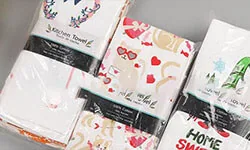
Short answer: Private label means the product carries your brand and your specification; it does not mean the mill has a stock towel waiting for your logo. What you are actually buying is a set of decisions: base construction and weight, size with its shrinkage allowance, colour and dye method, border and trim, artwork ownership, tooling, labelling content, packaging, the test plan, and the true economic minimum order. Get those closed in writing before the first purchase order and a private label order behaves like any other. Leave them open and the shipment arrives close to — but not quite — what you approved.
Wholesale buys a product. Private label creates one.
With wholesale you are choosing from something that already exists: a catalogue construction, a stock colour card, a size the mill already runs. Private label inverts that. The specification, the artwork and the packaging are yours, and the mill manufactures to your document rather than to its own catalogue. That is where the margin and the differentiation come from — and it is also where the risk moves.
A stock towel that arrives slightly off is a supplier problem to argue about. A private label range that arrives slightly off is your range, under your brand, in your market, and the returns land on your account. None of the decisions below are difficult. The failure mode is simply that nobody wrote them down, because everyone assumed the other side already knew.
The decisions that decide a private label range
| Decision | What it actually locks down | What an open decision costs you |
|---|---|---|
| Base product and weight | The cloth you are buying: construction, yarn type and count, finished piece weight | Two shipments of “the same” towel that feel different to your customer |
| Size, and the wash it survives | Cut dimensions and the shrinkage allowance applied to them | A fitted sheet that no longer grips, or a towel that reads small on the shelf |
| Colour and dye method | Whether colour comes from dyed yarn, piece dyeing or printing, and to which fastness standard | Shade drift between dye lots, and a claim on the first repeat order |
| Border, trim and fringe | Jacquard, woven, printed or plain; hem or fringe; how the edge is finished | Two quotes for “the same” towel that cannot be compared at all |
| Artwork and tooling | Who owns the design files, the print screens or embroidery programme, and what happens on reorder | Paying twice for the same tooling, or being unable to move supplier |
| Labelling content | Fibre composition, care instructions, origin, and any mark your market requires | A compliant product held at customs, or relabelling stock you have already paid for |
| Packaging | Polybag or box, hang tag, barcode, units per carton and carton dimensions | A retail design that turns out to be impossible to pack at the cost you modelled |
| Testing and certification | Which tests, on which fabric, per production lot or per year | A compliance problem discovered after the container has sailed |
| MOQ and lead time | The real minimum per colourway and per size, and the calendar that starts at artwork approval | An order that is only economic in one colour, two sizes and one season |
Artwork, tooling and who owns what
The most expensive private label disputes are rarely about quality. They are about ownership. Three questions need a written answer before you send anything: who owns the design, who holds the tooling — the print screens, the engraving, the embroidery programme — and what happens to both if you decide to move to another supplier.
A confidentiality agreement is the usual instrument for the first of those. Anything you send in order to get a quote — artwork, brand assets, market data, the packaging concept — should be covered before it leaves your side. On our own projects we work to a standard mutual agreement, and you are welcome to read it before sending us anything: our non-disclosure agreement for custom projects sets out what stays confidential on both sides.
Tooling needs the same treatment. Ask who pays for it, who stores it, how long it is kept, and whether it is transferable. A mill that keeps your screens for years removes a barrier to reordering; a supplier that holds them as leverage creates one. Neither answer is wrong, but you should know which one you have bought.
The minimum order is usually not the number in the quote
MOQ is normally quoted per design, which quietly hides the rest of the arithmetic. Tooling and machine setup are fixed costs: they are spread over the run, so the figure that matters is not the minimum the mill will accept but the volume at which the tooling stops distorting your unit cost. Every extra colourway, size and pack format carries its own setup, which is why four sizes of one design can cost far more per piece than four sizes of a construction the mill already runs.
That is the useful question to ask. Not “what is your MOQ” but “at what volume does the setup cost stop mattering, and what does the curve look like below it”. Our note on low-MOQ custom runs covers how to test a market from a small order without paying the tooling penalty twice.
Labelling: decided last, paid for first
Labelling is the decision that turns a nice product into a sellable one, and it is the one most often left until the packaging is already tooled. Fibre composition, care instructions and country of origin are not decoration: they are market-entry requirements, and the names you may legally use for a fibre are set by the market rather than by the mill. In the European Union, fibre names, composition and labelling obligations sit within the textiles regulation, and the requirements differ from those in North America and the Gulf.
So fix the label before you fix the pack. Confirm the composition figure the mill will actually certify, the care instructions the fabric can honestly carry, and any market-specific mark the buyer expects to see. A label change after the carton artwork is printed is one of the few costs in this process that cannot be negotiated away.
The two-minute test for any private label supplier
Send the brief and ask one question: what is missing from it? A mill answers with questions and a tooling list — yarn, weight, shrinkage allowance, screen count, label content. Someone forwarding a catalogue answers with a price and a stock photo. Which reply you get tells you more about the supplier than the quote does.
Before you sign the first purchase order
- A written specification for the base product: construction, yarn, weight, size, and the shrinkage allowance applied to that size.
- A signed, dated approval sample made from the same yarn on the same machine class as production will be.
- Artwork files, colour references, and the ownership clause covering both.
- A tooling list with cost, owner, storage responsibility and the reorder arrangement.
- Label content confirmed against the rules of each market you will sell in.
- A packaging specification with carton count and dimensions, so freight can be priced before the goods exist.
- A test plan: which properties, on which lot, by whom, and what happens if a lot fails.
- MOQ per colourway and per size, and lead time measured from artwork approval rather than from enquiry.
- Payment terms, and a written answer on who pays for tooling if the order is cancelled.
- One named approver on each side. A committee approving artwork is how a launch date slips.
Send that list with your brief and you will get fewer, better answers. It also shortens the sampling round, because the questions a mill would otherwise have asked you in week three have already been answered in week one — which is the cheapest way there is to protect a launch date. If you want to see where that calendar actually goes, our breakdown of custom towel order lead time maps it stage by stage.
The logo is the last thing on a private label order. The specification, the tooling and the label are what you are really buying.
Frequently asked questions
What is the difference between private label and OEM?
In practice the two overlap. Private label usually means a product built to your specification and sold under your brand; OEM means the manufacturer builds the product that carries someone else’s brand, which may be yours. Either way the mill is working to a document rather than to its own catalogue, so the discipline is identical.
Do I need my own artwork for private label?
You need artwork you have the right to use, which is not always the same thing. A designer’s file, a licensed motif and a brand asset all carry different permissions, and the mill cannot check that for you. Confirm ownership in writing before the file is sent to be engraved or screened.
Who owns the tooling for a private label design?
Whoever the contract says. Print screens, engravings and embroidery programmes are physical or digital assets that cost real money, and they are routinely left unmentioned. Decide the owner, the storage arrangement and the reorder terms before the first run, not after it.
What MOQ should I expect for private label towels?
There is no universal figure, because it is set by tooling, print setup and yarn minimums rather than by the towel. The useful framing is the volume at which setup stops distorting your unit cost — ask for that number, and for the price at the minimum, so you can see the curve instead of a single point.
Can I private label a towel that already exists in a catalogue?
Yes, and it is often the fastest route to market. The base construction stays, and your brand, colourway, border, trim and packaging change. What it does not remove is the specification work: you should still receive a written spec and an approval sample for the version you are actually buying.
Should I sign an NDA before sending designs?
Before you send anything you would not want copied, yes. A short mutual agreement covering artwork, brand assets and market data is normal in this trade and costs nothing but a signature. Treat a refusal to sign one as information about the supplier.
Send us the brief. We will send back what is missing.
Tell us the range, the market and the volumes you are planning. We will return a written specification, a tooling and MOQ breakdown, and a sampling calendar — so you can see the whole commitment before you make any of it.
Request a private label brief →Sinmal Production Team
Weaving & finishing, Sinmal Home Textile · Last updated October 2026
Keep reading
- Cotton Shrinkage in Towels and Linens — Specify the size after washing, not before
- Low-MOQ Custom Peshtemals — Testing a market from a small run
- Custom Tea Towel Branding Options — Print, embroidery, label or woven logo
- Bed & Bath Linens Catalog — Fabrics, weights and packing data
- Towel Inspection: 4-Point System and AQL — How a shipment is graded before it leaves the mill