
Custom Tea Towels for Brands: Every Branding Method Compared
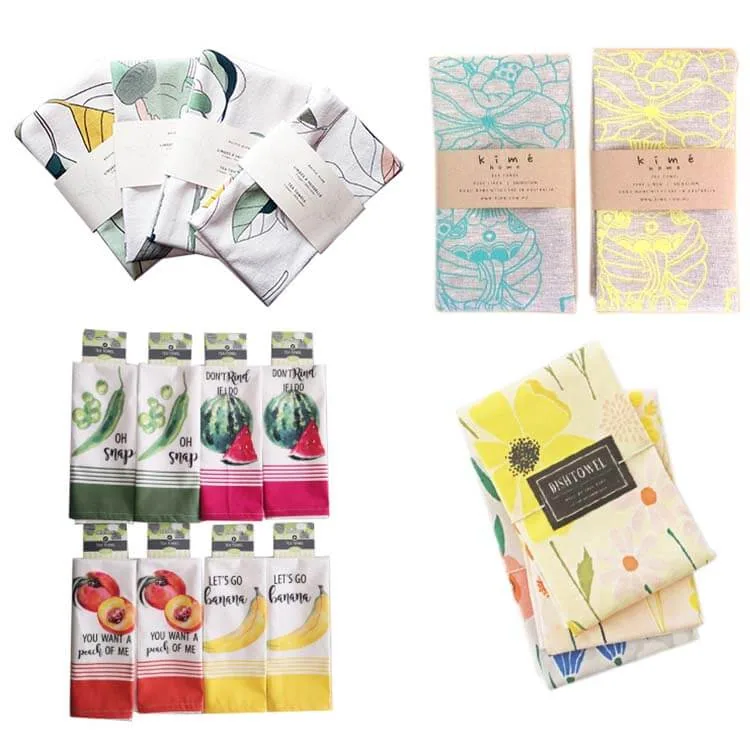
Short answer: There are five practical ways to brand a tea towel: screen print (bold spot colours, cheapest at volume), digital print (full-colour art, lowest MOQ), embroidery (premium hand feel, highest per-unit cost), jacquard weaving (the pattern IS the cloth — no print to fade) and woven labels / edge accents (subtle, cheap, often overlooked). Retail collections usually combine two: a printed body plus a woven label, which reads as “brand” without paying embroidery prices across the whole towel.
The five methods compared
| Look & feel | Typical MOQ | Cost behaviour | Durability | |
|---|---|---|---|---|
| Screen print | Solid spot colours, crisp edges | 300–500 pcs | Setup per colour; very cheap per unit at volume | Very good on flat weave |
| Digital print | Photos, gradients, unlimited colours | 100–300 pcs | Flat per-unit; no setup — scales poorly to huge runs | Good with cured inks |
| Embroidery | Raised, premium, tactile | 100–300 pcs | Stitch-count driven; costly on large areas | Excellent — outlives the cloth |
| Jacquard woven | Pattern woven into the fabric | 500–1000 pcs | Highest setup; strong at scale | Best — colour is the yarn |
| Woven label / edge accent | Subtle brand mark at hem or selvedge | Very low | Minimal | Excellent |
Match the method to the base cloth
Decoration and fabric are one decision, not two. On flour sack, soft-hand and water-based prints look native; heavy plastisol sits stiffly on the loose weave and cracks at the fold. Flat weave takes crisp screen prints and dense embroidery beautifully. Jacquard needs no print at all — stripes, checks and geometric motifs are woven in, which is why heritage kitchen brands default to it. For fine typographic detail on terry-adjacent surfaces, embroidery beats print every time.
The combination most successful brands use
A printed body (screen or digital) + a woven label at the hem. The body carries the design; the label carries the brand. It reads premium, survives the wash, and costs a fraction of full-embroidery pricing.
How the cost curve behaves
Indexed to a 500-piece single-colour screen print on flat weave (100%): digital runs roughly 0.9–1.3× depending on coverage; two to four colour screen drops toward 0.7× at 1,000 pieces; embroidery on a small logo lands around 1.2–1.8×; full jacquard starts near 2× and crosses below screen print only past roughly 3,000 pieces. Exact numbers depend on cloth, size and season — which is why we quote by project instead of publishing figures that age badly.
Artwork guidance that saves a sampling round
- Vector for logos and type (AI/PDF); 150–300 dpi raster for photographic art, sized at final dimensions.
- Limit spot colours where you can — every extra screen is setup cost and one more thing to register.
- Design for the fold: keep critical marks out of the outer 3 cm, and check how the design reads when the towel hangs folded over a rail.
- Pantone from a physical chip, never a screen — the same discipline that protects any bulk program.
The sampling workflow that avoids re-prints
Branding programs rarely fail at bulk; they fail between artwork and bulk. The four-stage approval that prevents it:
- Artwork review (day 1–2). The mill checks resolution, colour mode, bleed and placement on the actual base cloth — before anything is printed.
- Strike-off / print sample. The design printed or stitched on the production fabric, not a substitute. This is where hand feel and colour truth live.
- Washed sample. The strike-off run through 2–3 wash cycles. Print softness, colour hold and edge behaviour are judged on the towel customers will own, not the fresh one.
- Signed approval. A kept physical sample both parties reference at bulk QC. It converts taste into a standard.
The cost of this loop is days. The cost of skipping it is a bulk run of towels that “aren’t quite the colour” — which no discount recovers.
Five branding failures we see most
- Logo supplied at 72 dpi. Unfixable at print time; always the first thing to check.
- Missing white underbase on digital print over coloured cloth — the design looks muted and washed out on the first sample.
- Heavy plastisol on flour sack — a stiff plastic patch that cracks at the fold after three washes. Soft-hand or water-based inks belong here.
- Woven label at the neckline of a towel-style product — itchy, and the first thing customers cut out. Hems and corner pockets carry labels better.
- Pantone chosen from a screen. Calibrated monitors still disagree with dye chemistry; a physical chip costs a coffee and saves a remake.
Frequently asked questions
What is the lowest MOQ for branded tea towels?
Digital print on stock base cloth starts around 100–300 pieces — the practical entry point for testing a design before committing to volume.
Can I get my logo on flour sack towels?
Yes — screen print with soft-hand or water-based inks suits the loose weave best. Ask for a washed print sample to check hand feel after laundering.
Which method lasts the longest in the wash?
Jacquard (woven-in colour) and embroidery both outlive any print. Among prints, well-cured screen work on flat weave is the most durable.
Can I mix branding methods in one order?
Yes — printed body plus woven label is the most common structure. Different methods run on different lines, so they are quoted as separate processes.
Do you supply eco-friendly ink options?
Water-based and OEKO-TEX-compliant ink systems are available on request — tell us your certification target at enquiry stage so it is priced in, not retrofitted.
How many colours can a screen print carry?
Technically many; commercially two to four keeps cost and registration risk sane. Gradients and photography belong to digital print.
How long does the sampling loop take?
A clean loop — artwork review, strike-off, washed sample, approval — typically runs one to two weeks, and it is the cheapest insurance in the whole program.
Send the artwork — get two methods quoted side by side
Share your logo and target quantity. We will return the two best-fit branding routes with cost, MOQ and a washed sample of each.
Quote my tea towel program →Sinmal Production Team
Weaving & finishing, Sinmal Home Textile · Last updated September 2026
Keep reading
- Tea Towels & Dish Towels — Base cloths, sizes and custom options
- Flour Sack vs Flat Weave vs Terry — Choosing the construction