
Towel Inspection Before Shipment: The 4-Point System and AQL, Explained
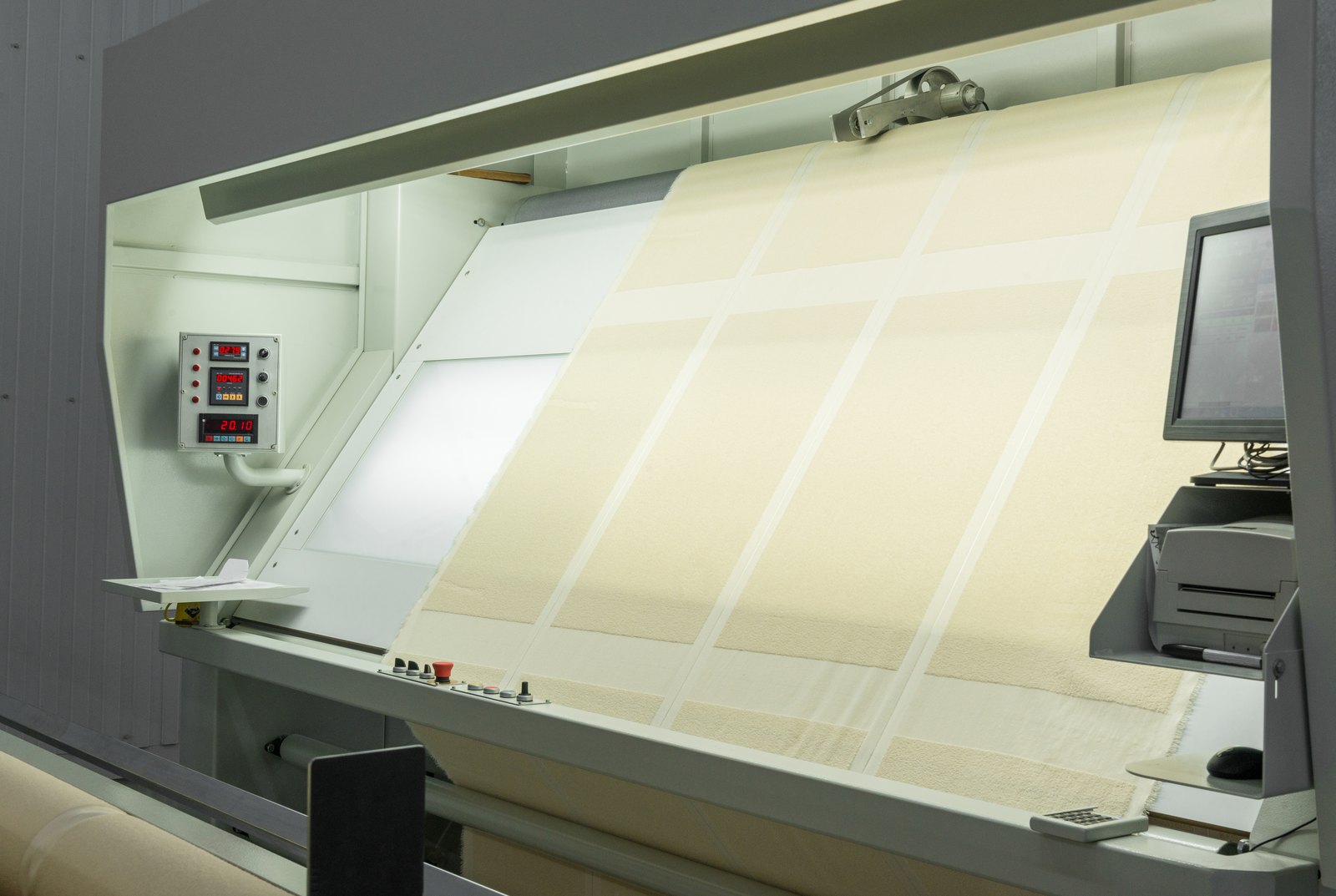
Short answer: A serious towel inspection runs on three layers, and each layer has a number. The fabric is graded with the 4-point system, where every defect costs penalty points by its length and the roll passes or fails on points per 100 square yards. The finished pieces are sampled with an AQL plan (ISO 2859-1; typically AQL 2.5 for major defects and 4.0 for minor, with zero tolerance for critical ones), which fixes how many cartons are opened and how many defective pieces the lot may contain. On top of both sits a conformance checklist — measurements, weight, shade, labels, packing — because sampling statistics never check those. Put all three in the purchase order and quality stops being a matter of trust.
Why “we check every piece” is not an inspection plan
Every mill says it inspects. The word means nothing until it is written as numbers, because the same sentence covers radically different realities: a sewer glancing at each towel as it leaves the machine, a packer spotting holes under a lamp, or a trained inspector measuring defects on a lighted table and recording them on a graded report. A buyer who accepts the sentence without defining it has agreed to all three at once.
An inspection plan answers exactly three questions: what is checked, how much is checked, and what score fails. The vocabulary below — 4-point, AQL, tolerance — exists to make those three answers identical on both sides of the table. Watch how much is hidden inside the phrases buyers hear every day:
- “Good quality” — no approved reference sample and no tolerances, so there is nothing to compare the goods against.
- “Fully inspected” — does not say whether defects were recorded, graded or just removed from the pile before you ever see the report.
- “Colourfast” — no test method and no minimum grade attached; the claim is unfalsifiable and worth nothing in a dispute.
- “Export standard packing” — undefined carton counts, no moisture protection, no shipping marks; freight claims start here.
- “Same as the sample” — true only if the sample was approved in writing and kept sealed as the arbitrating reference.
The 4-point system in plain numbers
The 4-point system grades fabric, not finished towels. Each roll — terry greige or finished piece goods — is unrolled on an inspection table or machine, and every visible defect is measured along its longest dimension and scored:
| Defect length | Penalty points | Typical towel examples |
|---|---|---|
| Up to 3 in (7.6 cm) | 1 | Slub, tiny stain, single missing loop, small yarn knot |
| Over 3 to 6 in | 2 | Running missing pile, narrow streak, small oil mark |
| Over 6 to 9 in | 3 | Long weft bar, visible dye streak, broken pick line |
| Over 9 in | 4 | Long missing-pile band, wide stain, warp break |
| Holes and openings | 4 — always | Any hole, tear or unfilled opening, regardless of size |
Two caps keep the arithmetic honest: a single linear yard can never accumulate more than 4 points, and a defect larger than 9 inches costs 4 points no matter how long it runs. The roll’s score is total points, normalised to points per 100 square yards. First-quality terry for hospitality programmes is commonly specified at 28–40 points per 100 square yards; a tighter number raises cost, a looser one raises the odds that a visible fault reaches the folding table. The exact threshold matters less than the fact that one is written down — a mill that knows the bar will cull rolls against it, and a buyer who knows the bar can audit the claim.
Fabric scoring is where the cheapest quality wins happen, because a roll rejected at inspection never becomes a towel. The same logic applies to weight: pile density shows up in GSM, and the bath towel GSM guide explains how a 500 GSM sheet of fabric that weighs out at 460 GSM in bulk is a specification failure long before it is a visible defect.
AQL: how many pieces to pull, and how many may fail
Finished-towel inspection is statistical. Nobody unwraps 4,000 towels; instead a sampling plan drawn from ISO 2859-1 (General Inspection Level II, normal severity) fixes how many pieces are pulled at random and where the accept/reject line sits. At the industry-standard AQL 2.5 for major defects, the arithmetic looks like this:
| Pieces in shipment | Sample code | Pieces to inspect | Accept if major defects | Reject if major defects |
|---|---|---|---|---|
| 91–150 | F | 20 | ≤1 | ≥2 |
| 151–280 | G | 32 | ≤2 | ≥3 |
| 281–500 | H | 50 | ≤3 | ≥4 |
| 501–1,200 | J | 80 | ≤5 | ≥6 |
| 1,201–3,200 | K | 125 | ≤7 | ≥8 |
| 3,201–10,000 | L | 200 | ≤10 | ≥11 |
Read one row concretely: an order of 1,000 towels opens 80 of them, and up to 5 major defects is a pass. A major defect is one a customer would notice or that affects use — a visible stain, a hole, a broken seam, a towel 8% short of the ordered length. Minor defects (a loose thread, a slightly wavy hem) run at AQL 4.0 with its own accept numbers. And some defects are not defects at all but failures: a needle fragment or any metal contamination, mould, a wrong or missing care label, or a carton short of its declared count are critical defects with zero tolerance — a single occurrence fails the lot regardless of the sample score, because a needle in a hotel towel is a guest-safety incident, not a quality statistic.
What AQL does not cover — and the checklist that does
AQL counts visible faults on sampled pieces. It will not tell you whether the towels are the right size, the right weight, the right colour or packed the right way, because those are conformance questions, not defect counts. They belong on a short checklist executed alongside the sampling:
- Measurements: laid-flat dimensions against the spec, typically within ±2% for length and width — a shrinkage spec belongs here too, sized after wash rather than before.
- Weight: pieces weighed and converted to GSM, compared to the ordered band; the GSM guide explains what each band buys.
- Shade: sampled pieces compared against the approved lab dip or strike-off under a standard light source, and across cartons for within-lot continuity — the failure mode behind the dye-lot consistency guide.
- Hand feel and finish: against the sealed approved sample, including hem, border and any embroidery or print placement — the exact gap the sample versus bulk quality guide addresses.
- Labels and care instructions: composition and care symbols correct, permanent and legally placed; the symbols themselves are the GINETEX care labelling system, so laundry teams read identical instructions worldwide.
- Packing: carton counts and assortment, polybags, carton marks, and moisture — a damp carton is a mould claim waiting for a container door to open.
Three checkpoints, not one
Pre-shipment inspection catches what escaped, but the cheapest quality is built earlier. A full programme puts eyes on the order three times: at pre-production, when the PP sample fixes everything the bulk will be judged against — construction, dimensions, GSM band, shade, hand feel, labels; during production, when in-line checks at roughly 10–20% completion catch systematic faults while the line can still correct them the same day; and pre-shipment, when the AQL plan runs on packed, ready-to-ship goods. A mill confident in its first two checkpoints will still welcome the third, because a clean pre-shipment report is evidence it can show the next buyer.
Defects are inspected out; specifications are agreed in
The most expensive quality failures are not defects an inspector missed — they are spec gaps no inspector could catch: a GSM band never pinned, a size tolerance never written, a shade judged with no approved reference. Money is saved at the pre-production stage, one paragraph of purchase order at a time.
Writing inspection into the purchase order
None of the above protects you if it lives in a phone call. Four lines turn it into a contract:
- Name the systems: 4-point fabric grading with a points-per-100-square-yards limit, ISO 2859-1 Level II sampling, AQL 2.5 major / 4.0 minor, zero critical.
- Name the tests: lab colourfastness and washing performance measured to recognised methods — the test library published by AATCC is the standard reference hospitality buyers quote — with minimum grades, and require the reports with the shipment.
- Name the reference: the sealed approved sample plus written tolerances arbitrate every dispute, not production memory.
- Name the remedy: fail means rework and re-inspection at the mill’s cost, discount against the defect rate, or rejection — decided before the order, not after the report.
An inspector finds defects; a specification prevents them. A good order pays for both.
Frequently asked questions
What is the 4-point system in towel inspection?
A fabric grading method where each defect costs 1 to 4 penalty points by its longest dimension (up to 3 in = 1 point, 3–6 in = 2, 6–9 in = 3, over 9 in = 4; holes always 4, capped at 4 points per linear yard). The roll passes or fails on total points per 100 square yards against a limit written in the purchase order.
What AQL should I use for towel orders?
AQL 2.5 for major defects and 4.0 for minor defects under ISO 2859-1 General Inspection Level II is the industry norm for towels and linens. Critical defects — needle or metal contamination, mould, wrong care labels — carry zero tolerance: one occurrence fails the lot.
How many pieces of my order will actually be inspected?
The sample size scales with the lot, not with the order: about 20 pieces for a 100-piece shipment, 80 for 1,000 and 200 for 10,000, pulled at random across cartons. The exact accept/reject numbers come from the ISO 2859-1 tables, which is why they should be quoted in the order rather than negotiated after the report.
Which towel defects matter most?
Critical first: needle fragments and metal contamination, mould, and missing or wrong care labels. Then majors a guest would notice: holes, stains, broken seams, wrong size or weight, shade off the approved standard. Minor faults such as loose threads or slightly irregular hems are counted separately at the looser AQL.
Should I hire a third-party inspector?
For a first order with a new mill, or for large seasonal buys, an independent pre-shipment inspection is cheap insurance and the report is shared evidence. For established programmes, a mill with documented in-line QC plus a joint inspection standard in the PO usually delivers the same outcome — the key is that both sides grade against the same numbers either way.
Can the factory inspect its own shipment?
Yes — self-inspection against an agreed plan is standard practice and a sign of a mature mill, provided the criteria, sample sizes and thresholds are written in the purchase order and the approved sample is sealed. Many buyers combine mill self-inspection on repeat orders with third-party inspection on new constructions, new colours or first orders.
Shipment quality you can measure, not hope for.
Tell us the programme and we will quote with the inspection plan attached: 4-point limits, AQL sampling, sealed references and lab reports with every shipment.
Request an inspected towel quote →Sinmal Production Team
Quality control & shipping, Sinmal Home Textile · Last updated October 2026
Keep reading
- Towel Dye Lots and Colour Consistency — Why repeat orders drift — and how lab dips lock the shade
- Sample vs Bulk Quality — Why approval samples and bulk lots diverge
- Bath Towel GSM Guide — The weight band behind every inspection checklist
- Custom Towel Order Lead Time — Where inspection fits in the production calendar