
Waffle, Terry or Kimono? Choosing Bath Robe Fabric by Property
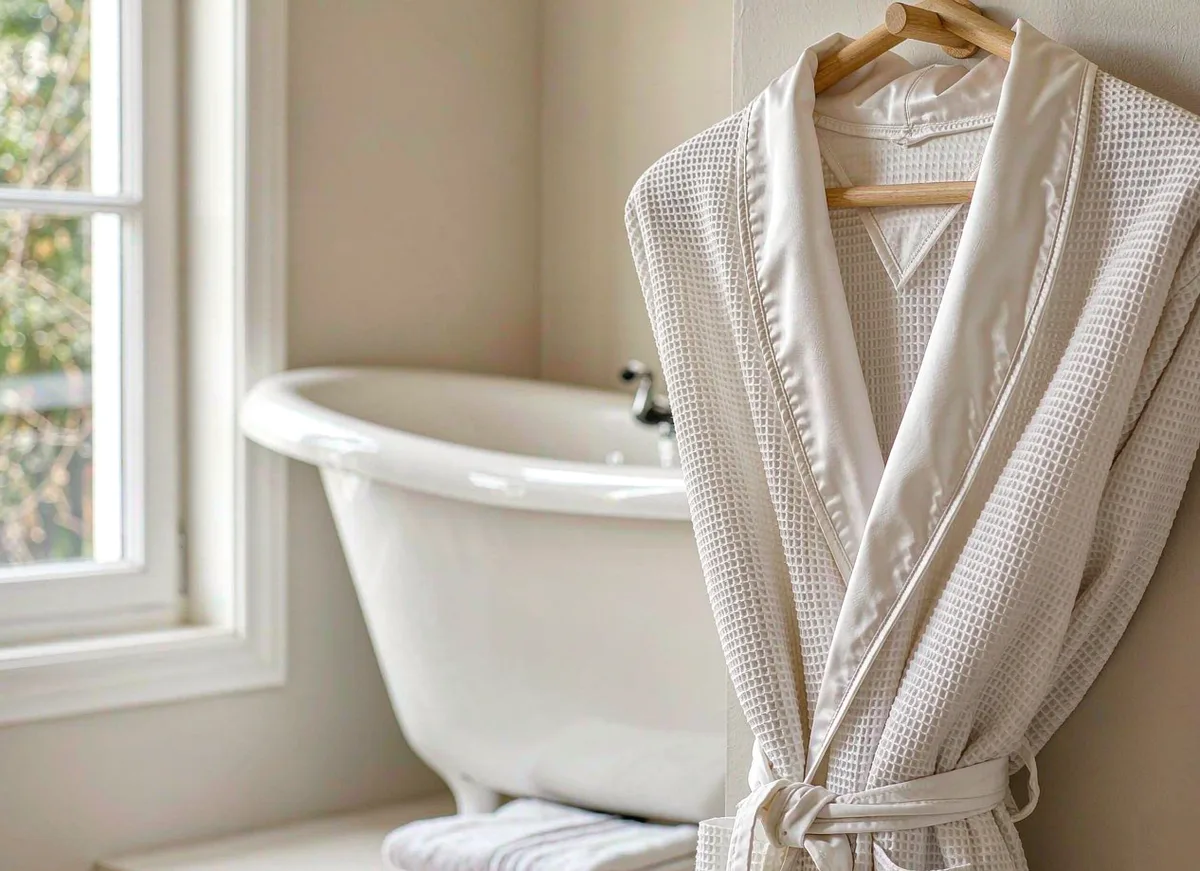
Short answer: Choose robe fabric by climate and laundry first, brand second: waffle weave is light, breathable and the safest all-season choice; terry (usually 350–450 GSM) is the plush post-shower classic but the heaviest to launder; kimono-style lighter terry or waffle balances both for resorts; microfiber suits spa and poolside only. A 380 GSM waffle robe feels more luxurious than a badly finished 450 GSM terry — construction beats weight here more than anywhere in linen.
The four robe fabrics compared
| Waffle weave | Terry | Kimono (light terry/waffle cut) | Microfiber | |
|---|---|---|---|---|
| Weight range | 250–350 GSM | 350–450 GSM | 300–400 GSM | 200–280 GSM |
| Season | All-season, best in warm rooms | Cool seasons, cold climates | All-season | Summer / poolside |
| Feel | Crisp, breathable, slightly textured | Plush, absorbent, heavy | Soft, draping, lighter terry loop | Suede-smooth, quick-dry |
| Laundering | Easiest — fast wash and dry | Heaviest — long dryer cycles | Moderate | Easy, but heat-sensitive |
| Absorbency | Medium | Highest | High | High for its weight |
| Perception | Spa / boutique | Full-service hotel | Resort / premium retail | Active / pool |
| Watch out for | Snagging on rough jewelry | Drying capacity, stiffening with softener | Belt and pocket anchoring | Looks cheap if pile flattens |
Weight: the number guests never see but always feel
Robe weight is dominated by the fabric GSM and the cut length — a full-length robe uses roughly 1.6–2.2 m of fabric, so every 100 GSM of fabric weight adds 160–220 g to the garment. Spec both together: a 380 GSM waffle in full length wears heavier than a 420 GSM short kimono. For programs, the practical ladder is: 280–320 GSM waffle for warm-climate hotels, 350–400 GSM as the all-rounder, 420–480 GSM terry for winter and destination spas.
The laundering reality (learn from the towel chapter)
Everything that applies to towels going hard after washing applies to robes, amplified by garment construction: seams, belts and pocket bags are where terry robes fail first. Spec double-needle seams at stress points, self-fabric belts with a defined attachment (tunnel loop or secure pin-on for laundry — never loose after washing), and pre-shrunk fabric with a stated tolerance, because a robe that shrinks 5% no longer fits its size set.
Sizing: the most common program mistake
Robes are bought in size sets, and the set is where programs go wrong. A sensible hospitality spread:
| Size | Chest (garment) | Typical share | Notes |
|---|---|---|---|
| S/M | up to ~112 cm | ~20% | Unisex cut keeps the set simple |
| L/XL | ~114–124 cm | ~55% | The workhorse size — never run short |
| XXL | ~126–136 cm | ~20% | Stock-outs here generate complaints |
| 3XL / kids | custom | ~5% | Offer, don’t default |
The detail that reads as luxury
Hanger loop inside the collar, a defined belt with two loops, and a chest pocket set high enough to clear the belt knot. Three cheap details that make a mid-weight robe feel bespoke — and they cost almost nothing to add at the cut stage.
What changes after twenty industrial washes
The robe that arrives in your sample box is not the robe your guests wear in month six. Two fabric behaviours decide whether a program ages well:
- Terry pile flattens before it wears out. After 15–25 industrial cycles, loop height drops and the surface reads thinner even though the cotton is intact. Higher twist yarn holds loft longer; low-twist “fluffy” terry looks generous on day one and tired by month three.
- Waffle keeps its structure but can stiffen if the laundry over-softens it. The grid pattern is set at the loom, so it survives washing better than pile — but silicone softener builds up in the grid and kills absorbency. Dose softener by fabric weight and never exceed the supplier’s recommended rate.
- Both shrink if the fabric was not pre-shrunk. Robes and towels from the same program should share one stated shrinkage tolerance so they still look like a set after a year of laundering.
A robe is the only linen a guest wears against skin without a layer in between — which is why a mediocre robe is remembered, and a good one is not.
Embroidery, labels and branding on robes
Robes are the most branded item in a hotel or spa linen program, and the easiest to get wrong. Three placements carry almost all programs: left chest for hotel and resort logos, cuff or inner collar for understated marks, and back yoke for spa and pool robes where the logo is read from behind.
Practical constraints worth writing into the spec: keep stitch counts modest on waffle, because the textured surface breaks fine lines and small lettering; approve embroidery on the actual production fabric, not a flat cotton sample; and specify that embroidery happens before garment cut so the panel is framed evenly. Add a woven care label with fibre content and wash instructions, plus an internal size label — laundry loses robes when the size marking fades.
The branding mistake that costs a program
Sending a logo file and expecting placement to sort itself out. Confirm the embroidery file, the exact placement height from the shoulder seam, the thread colour (Pantone, matched to your fabric not to a screen) and one physical approval sample before bulk. It adds days now and saves a re-run later.
How to write a robe spec the mill cannot misread
Most robe disputes trace back to a spec that omitted one number. A complete robe enquiry should state:
- Fabric and construction — waffle, terry, or light terry kimono cut, with GSM.
- Cut and length — shawl collar or kimono, short / knee / full length in centimetres.
- Size set and split — for example S/M, L/XL, XXL in your expected proportion, plus chest measurement per size.
- Trims — belt type and attachment, belt loops, pockets, hanger loop, piping or contrast trim.
- Branding — embroidery or printing placement, file, thread colour, label type.
- Finishing and tolerance — pre-shrunk, stated shrinkage tolerance, colourfastness and pilling requirement.
- Packing — poly bag per robe, size sticker, hangtag, carton count and carton mark.
Send that list to three suppliers and compare like for like. The quote differences you see afterwards will be real differences in fabric, finishing and packing — not arithmetic. For how robe construction sits alongside the rest of the bath range, see our custom bath linens capability and the fabrics we weave.
On pricing, expect the same levers as towels: fabric weight, cut length, trim count, branding complexity and packing. Two quotes for the “same” robe can differ by tens of percent and both be correct — one is a 280 GSM short kimono with screen printing, the other a 450 GSM full-length terry with embroidery and a lined collar. Ask each supplier to break the price by weight and trim so you compare the same robe.
Because a robe is worn directly against skin for long periods, the certification to ask for is the finished-article one: OEKO-TEX STANDARD 100 tests the garment as delivered, including trims, belts and embroidery thread, at the strictest class used for articles with intensive skin contact.
Frequently asked questions
What GSM is best for hotel bath robes?
280–350 GSM waffle for warm climates and fast laundries; 350–450 GSM terry where plushness sells. Judge GSM together with cut length — total garment weight is what guests feel.
Waffle or terry for a spa?
Waffle for treatment areas and warm pools (breathable, fast-drying), terry for post-treatment relaxation zones. Many spas carry both and let guests choose.
Why do robe belts disappear in laundry?
Loose belts are separated, lost or laundered wrong. Spec an attached tunnel loop or a defined wash procedure — and buy 10–15% spare belts.
Do robes shrink in industrial laundry?
Unpre-shrunk fabric shrinks 4–8%, which breaks the size set. Insist on pre-shrinking with a stated tolerance (2–5%) confirmed by wash test.
What is a kimono robe exactly?
A cut style — straight, draped, minimal seaming — rather than a fabric. It is usually made in lighter terry or waffle, which is why it wears lighter than a full-cut terry robe.
Can robes be embroidered with a logo?
Yes — chest embroidery is standard. Keep designs modest in stitch count on waffle (the texture distorts fine detail) and place embroidery before garment cut for the cleanest result.
We will match the robe to your laundry and climate
Tell us your property type and laundry setup. You will get fabric, weight and size-set recommendations with physical samples — including a washed one, because that is the robe guests actually wear.
Request robe samples →Sinmal Production Team
Weaving & finishing, Sinmal Home Textile · Last updated September 2026
Keep reading
- Bathrobe Sizing for Hotels — The five measurements that decide the fit
- Hotel Bath Robe Care & Replacement — When to repair a robe and when to retire it
- Our Bath Linen Range — Robes, towels and sheet programs
- Custom Bath Linens — Towels, mats and robes to spec
- Why Towels Go Hard After Washing — The laundering rules robes follow too