
Bathrobe Sizing for Hotels: How to Fit a Robe Programme to Your Guests
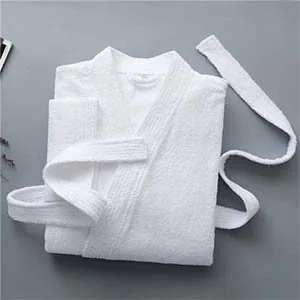
Short answer: Guests almost never complain about a bathrobe — they simply leave it on the hook. What reads as a fabric problem is nearly always a sizing one. Fitting a property is not a matter of picking a brand’s S, M or L: it is five measurements with tolerances, a stated size split, and a shrinkage allowance already built into the cut size. Get those three right and the programme stops generating complaints. Get them wrong and no upgrade in fabric will rescue it.
A robe that does not fit is a robe that is never worn
A guest puts the robe on once, feels the shoulders pull or the hem sit at mid-thigh, and reaches for the towel instead. The property reads that as “our guests do not use robes”, drops them from the next refurbishment, and never learns that the issue was a pattern rather than a preference. That is the expensive version of a sizing mistake, because it removes the amenity from the room and takes the upsell with it.
In retail the arithmetic is more direct but the mechanism is identical: a robe returned for fit costs more than the margin on the sale. Robes are worn over bare skin, so the fit is judged instantly and without mercy.
Why fit goes wrong more often on robes than on towels
| What goes wrong | How it shows up in the room | The root cause |
|---|---|---|
| One size is made to do everything | Tall guests wear a tunic; smaller guests swim in it | A single size was bought to simplify purchasing, not to fit a population |
| Chest and sweep treated as the same number | The front will not close over the overlap the guest expects | Sweep is quoted as a chest figure; the two measurements are not interchangeable |
| Length judged on a hanger | The hem sits above the knee on a tall guest | Back length was measured flat on a table, never on a body |
| Belt length and loop height left unstated | Belt ends do not meet, or the belt drifts below the waist | Nobody specified where the loops sit or how much belt is needed |
| Fit quoted before washing | Fits on delivery, grips and rides up by month three | The shrinkage allowance never made it into the cut size |
The five measurements that decide the fit
A robe specification needs five numbers before anything else is discussed. Every one is taken on the finished article, and every one needs a tolerance — a single figure with no tolerance is an opinion.
| Measurement | How it is taken | Why it decides the fit |
|---|---|---|
| Back length | From the collar seam at the centre back straight down to the hem | The most visible number of all: it decides whether the robe reads as knee-length, mid-calf or a tunic |
| Sweep (body width) | Half-chest across the body, doubled, measured flat | Decides whether the front closes with the wrap a guest expects, and how the robe hangs |
| Shoulder and sleeve | Shoulder point to shoulder point; shoulder point to cuff | Wrong sleeve length is what makes a robe feel borrowed — and a dropped shoulder reads as oversized rather than relaxed |
| Belt and loop height | Belt laid flat, measured end to end; loop height measured down from the centre-back collar seam | A belt that only just meets will not stay tied, and loops set too low make any robe look short in the body |
| Collar and closure | Shawl depth, or kimono band width across the front opening | A deep shawl collar uses several centimetres of the body measurement before the belt is even tied |
Then there is the sixth figure, which is not a measurement at all: the shrinkage allowance. A cotton or terry robe that loses a few percent in each direction has quietly moved all five of the numbers above by the time it has been through a commercial laundry a few times.
What a size ladder usually looks like
Exact figures belong to your own sample and your own market, and body size distributions differ sharply between them. The ladder below is a reasonable starting point for a hospitality programme — indicative, to be confirmed line by line on a physical sample before you commit.
| Size | Typical body fit | Back length (collar to hem) | Notes |
|---|---|---|---|
| S / M | Narrower frames, roughly to 100 cm chest | Around 110–115 cm | Frequently dropped from a range, usually wrongly — it is also the first to sell out in retail |
| L / XL | The widest part of most adult populations | Around 115–120 cm | Normally the highest-volume size in a hotel programme |
| XL / 2XL | Broader frames and taller guests | Around 120–125 cm | Add this before you add a fourth size |
| One size fits most | A single size, cut generously | Usually 115–120 cm | Covers the middle of a population; awkward at both ends of it |
“One size fits most” does not mean one size fits all
A one-size robe is a legitimate commercial decision, and for a spa or a poolside it is often the right one. But it is a pattern that has been widened to cover the middle of a population, so it will always look short on a tall guest and loose on a small one. Buy it deliberately, and keep one or two other sizes on the shelf for the guests it does not serve.
How many sizes does a property actually need?
Most hotels need two or three. The useful question is not which sizes exist, but what your guest population looks like and what you are prepared to stock and sort:
- Let the middle size carry the volume. A 60/30/10 split across three sizes is common and far cheaper than a flat split that leaves the extremes sitting in the store.
- Match sizes to room types. Suites, spa treatment rooms and changing areas are where the larger sizes get used. Standard rooms rarely justify a full ladder.
- Mark the size on the garment. If the size is not marked somewhere that survives a hundred washes, the laundry will sort it wrong and the split on the shelf will drift within a season.
- Decide the replacement unit, not just the purchase unit. A size ladder is a decision you re-make every time a batch wears out, so buy it in a mix you can restock.
Collar and closure change the fit more than guests realise
A shawl collar wraps a layer of fabric across the chest before the belt is tied; a kimono or wrap collar closes flatter and takes less off the body. Two robes with identical body measurements and different collars fit differently, which is why a specification that names only a sweep figure will produce an argument at the sample stage.
The closure matters just as much. Belt loops are not decoration — they hold the belt at the height the robe was designed to be tied at, and they stop it from finding its own way down the body. A robe that relies on the guest to keep the belt in place will always look untidy, and guests read untidy as cheap.
Weight is part of fit, not a separate conversation
A heavier robe hangs; a lighter one clings. The same pattern in a light terry and in a dense waffle behaves completely differently on a body, and the size that worked in one can look wrong in the other. Our guide to robe fabrics for hotels and spas works through how each construction drapes, absorbs and ages — worth settling before the size ladder is fixed, not after.
Cotton Incorporated publishes a useful reminder in this area: the properties that make cotton comfortable are the same properties that make it move, and a robe is where both effects are most visible.
The size you ship is not the size they wear
Every woven cotton robe moves in the wash. If the cut size was never given an allowance for it, a robe that fitted on delivery is a size smaller by the end of its first quarter in service — shorter in the body, tighter across the sweep. It is the same mechanism behind cotton shrinkage in towels and bed linen, applied to a garment, where the consequence is a guest complaint rather than a slightly smaller towel.
So the specification should carry a shrinkage figure with a direction and a tolerance, and the cut size should already include it. Ask the mill to show both the cut size and the finished size it is promising, and the allowance that connects the two — see also what laundering does to a robe over its service life, because the wash regime decides how much of that allowance gets used up.
What to put on the robe specification sheet
- Item, market and end use — in-room, spa treatment room, poolside or retail; each one changes the weight and the cut.
- Construction and weight: fabric, weave and the weight being bought, expressed the same way throughout the order.
- The five measurements above, each with a tolerance, all taken on the finished article.
- The size split you intend to stock, so the mill costs the ladder rather than a single size.
- The shrinkage allowance applied to the cut size, with the tested figure and the wash cycle it was measured on.
- Collar type, closure, belt length and loop height — stated, never assumed.
- Branding and labels: embroidery placement, label position, and how the size is marked on the robe itself.
- Care label wording, and the wash regime you will actually run.
One further line is worth adding for any robe worn against skin: state the skin-contact certification you require. OEKO-TEX® STANDARD 100 is the reference most hospitality buyers mean when they ask for “tested for harmful substances”, and it is far easier to agree at quotation stage than to retrofit onto a delivered order.
A robe is the only textile in the room that a guest wears. Everything a towel is allowed to get away with, a robe is not.
Frequently asked questions
What sizes do hotels usually stock for bathrobes?
Most properties run two or three: a smaller size, a large or extra-large that carries the volume, and often one larger size for suites and spa use. The split matters more than the number of sizes, and the middle size should always be the one you buy deepest.
What is the standard length of a hotel bathrobe?
There is no universal standard, because length is a positioning decision rather than a technical one. In-room robes are commonly cut to around 115 to 120 cm from collar to hem, which reads as mid-calf on an average-height adult and above the knee on a tall guest. Spa robes are often shorter. Choose the figure against your guest population, then state it.
Does a bathrobe need a shrinkage allowance?
Yes, if it contains cotton, terry or any cellulosic fibre. The allowance belongs in the cut size, and the tested figure with its wash cycle belongs on the specification. Without both, the robe will fit on delivery and not in service.
What is the difference between chest and sweep?
Chest is a body measurement. Sweep is the flat measurement of the garment across the body, doubled. Robes are quoted on sweep, and treating the two as interchangeable is one of the most common reasons a robe arrives too tight.
Is a one-size bathrobe a good idea?
It is a reasonable choice for spas, pools and short-stay use, where stocking a ladder is impractical. Understand what you are buying: a compromise cut that covers the middle of a population, and will look short on tall guests and loose on small ones.
Should robes be measured before or after washing?
Both. Ask for the finished size as delivered and the size after the wash cycle the care label specifies. The difference between those two figures is the allowance you are actually paying for.
Tell us the guest profile. We will quote the size ladder.
Send the property type, the markets your guests come from and the wash regime your laundry runs. We will come back with the cut, the size split and the shrinkage allowance already built into the cut size — on a sample, before the order.
Request a robe sizing quote →Sinmal Production Team
Weaving & finishing, Sinmal Home Textile · Last updated October 2026
Keep reading
- Bath Towel Sizes Explained — Cut size vs finished size, and the tolerance to agree
- Hotel & Spa Bath Robe Fabric Guide — Terry, waffle and velour, and how each one drapes
- Robe Care and Replacement Cycles — What laundering decides over a service life
- Cotton Shrinkage in Towels and Linens — The allowance that belongs in the cut size
- Private Label Towel & Linen Checklist — Every decision to close before the first order