
Flour Sack vs Flat Weave vs Terry: Choosing Tea Towels That Actually Dry
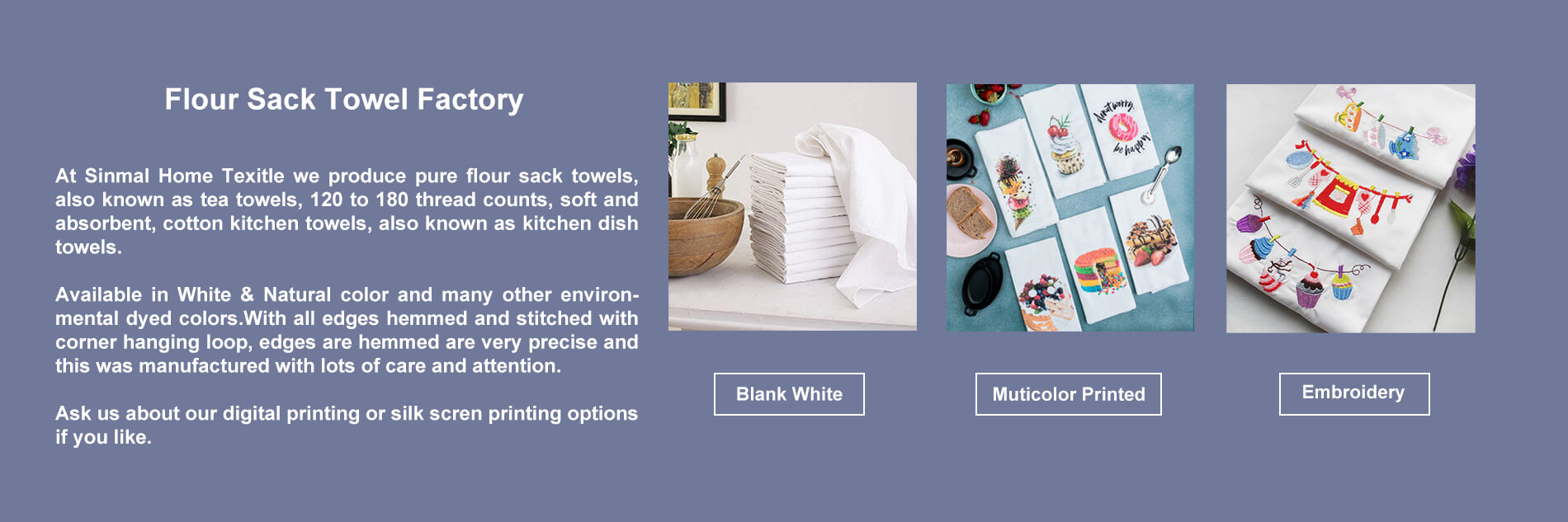
Short answer: Flour sack tea towels (loose plain-weave cotton, washed to a soft hand) are the best all-round driers: high absorbency, virtually zero lint, safe on glassware. Flat weave / herringbone towels are the durable workhorse — smooth, quick-wringing, excellent for print — while terry absorbs the most liquid but is too bulky for glass and slow to dry. For most kitchens and retail programs, flour sack is the default; flat weave wins where durability and branding carry more weight than polish.
The three constructions compared
| Flour sack | Flat weave / herringbone | Terry (looped pile) | |
|---|---|---|---|
| Construction | Loose plain weave, fully washed | Dense plain or herringbone weave | Cut or looped pile surface |
| Absorbency | High — wicks fast, wrings out well | Medium–high | Highest capacity |
| Lint on glassware | Almost none | Low | Noticeable — loops shed on glass |
| Drying speed | Fast | Fastest | Slowest — dense pile holds water |
| Durability | Good; softens with age | Best — tight weave resists snags | Good until loops snag |
| Print / embroidery surface | Excellent for soft-hand prints | Excellent — smooth and stable | Good for embroidery; print needs care |
| Best for | Glassware, everyday kitchens, retail sets | Busy kitchens, promotional programs | Pot holders, spills, bath-adjacent uses |
Why flour sack keeps winning the glassware test
Glassware demands two things at once: water pickup without pressure and no fibre transfer. Flour sack’s loose weave wicks by capillary action, so a light wipe lifts the film of water instead of pushing it around, and its fully-washed yarns leave essentially nothing behind. Terry does the opposite: great capacity, but the loops both shed and cushion — which is why a terry towel “cleans” a glass into a linty haze.
The second, quieter advantage is drying between uses. A towel hung over the rail between tasks must itself dry or it becomes the dampest thing in the kitchen. Flat weaves flash-dry; flour sack dries fast; terry stays clammy for hours. In humid kitchens this alone decides the program.
What to put in the spec
- Fabric weight: flour sack commonly runs 180–280 GSM (lighter than it sounds — the weave does the work); flat weave 200–300 GSM.
- Washed / pre-shrunk finish: non-negotiable. Unwashed flour sack shrinks and twists; insist on a stated shrinkage tolerance.
- Edge treatment: mitred or double-turned hems stop the curling that makes cheap tea towels look tired after five washes.
- Size logic: 45×70 cm is the versatile standard; larger 50×80 suits pizza and bread work; smaller bar towels live at the sink.
- Yarn: combed cotton for anything printed; ring-spun holds detail, open-end fuzzes.
The details buyers only notice after launch
Hem curl, corner sag and a print that fades below the fold line — all three are specification failures, not bad luck. All three are catchable in a washed sample, which is why our sampling stage includes wash tests.
Choosing by use case
| Program | Recommended construction | Why |
|---|---|---|
| Café / restaurant line | Flat weave (herringbone) | Survives constant wringing and industrial wash; looks crisp |
| Retail tea towel sets (printed designs) | Flour sack | Soft hand, superb print surface, gift-friendly fold |
| Homeware brand core range | Flour sack + one flat weave style | Covers polish and workhorse in two SKUs |
| Bar / glass station | Flour sack, smaller size | Lint-free finish is the entire job |
| Promotional give-aways | Flat weave, screen print | Lowest cost per unit at volume, durable logo |
How the weave decides everything
Flour sack’s performance is not an accident of thinness — it is engineered. The loose plain weave with an open pick spacing creates thousands of tiny capillary channels, which is what pulls water off glass without pressure. Two specifications govern it:
- Yarn quality: combed, ring-spun cotton (long fibres, combed short ones out) wicks cleanly and barely sheds. Open-end yarn feels similar new but pills and fuzzes within ten washes — and that fuzz is exactly the lint you bought flour sack to avoid.
- Weave density: too tight and it stops wicking, behaving like a flat weave; too loose and it snags and distorts. The workable band is narrow, which is why flour sack is less forgiving to make cheaply than it looks.
The wash finish: where flour sack is won or lost
Unwashed flour sack is a stiff, shrinks-4% cloth that nobody would sell twice. The value is added in finishing:
- Scour and bleach to a clean white (or light ground for printing).
- Mercerisation (optional, for premium lines) — adds lustre and dye affinity.
- Pre-shrinking with a stated tolerance — 2–5% residual is the professional norm; anything looser warps hems.
- Soft wash and tumble finish — this mechanical break-in is what makes the cloth feel broken-in on day one, and it cannot be simulated by fabric softener.
This is why two “identical” flour sack quotes differ: one prices the finishing steps, one skips them. The ordering process exists precisely so the difference is visible in a washed sample, not a sales page.
Frequently asked questions
What exactly is a flour sack tea towel?
A loosely woven plain-weave cotton towel, named for the sacks flour was once packed in. It is washed and softened, giving a cloth that wicks fast and leaves no lint on glassware.
Do flour sack towels shrink?
Unwashed ones do, noticeably. Properly washed and pre-shrunk fabric shrinks 2–5% and then holds shape — always confirm the finish and a stated tolerance.
Which tea towel is best for printing?
Both flour sack and flat weave print well. Flat weave gives the crispest fine detail; flour sack gives the softest hand. Combed yarn beats open-end for print clarity on either.
Why does my tea towel smell sour by evening?
It is not drying between uses — a construction or laundry issue, not a fabric defect. Lighter weights, adequate hanging space and hot washes fix it.
Are terry tea towels useless?
No — they are spill and pot-holding specialists. They are simply the wrong tool for glassware and slow to dry between tasks.
What sizes are standard for custom tea towels?
45×70 cm and 50×70 cm are the retail standards; 38×60 cm suits bar work. Custom sizes are straightforward, but keep within standard loom widths to protect cost.
Why do flour sack towels get better with age?
The long cotton fibres in a combed yarn soften and separate with washing instead of breaking — the cloth keeps wicking and keeps improving for dozens of washes, which is also the retail story worth telling.
Not sure which construction fits your program?
Tell us what the towel must do — glassware, retail line, promo — and we will send washed samples of the two constructions that fit, with your artwork on them.
Request tea towel samples →Sinmal Production Team
Weaving & finishing, Sinmal Home Textile · Last updated September 2026
Keep reading
- Tea Towels & Dish Towels — The full custom range
- Custom Tea Towel Branding Options — Print, embroidery, jacquard compared