
Kids Bedding Linens: Fabrics, Sizes and Safety for Children’s Beds
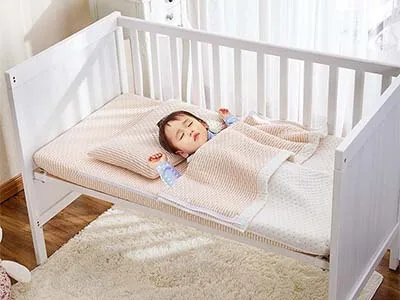
Short answer: Children’s bedding is a separate specification in four ways. Fabric: lighter and cooler, typically a plain-weave cotton around 110–145 g/m² rather than a heavy sateen. Fit: fitted sheets cut with deeper pockets and a shorter drop, because cot and toddler mattresses are thin. Print and dye: colourfastness that survives frequent hot washing, with pigment limits set to the strictest textile class. Trims: no cords, no drawstrings and no small detachable parts anywhere on the item. Most failures in this category are not fabric failures at all — they are fit and trims.
Why kids bedding is not adult bedding, smaller
- The mattress is a different shape. A cot mattress is thin — often a fraction of an adult depth — so an adult fitted sheet, scaled down, is baggy at the corners exactly where it needs to grip.
- It is washed more often, and hotter. Accidents, spills and illness mean a kids sheet may be washed several times more often than an adult one, and usually at a higher temperature. Fabric and print are both tested by that.
- The buyer is not the user. A parent buys on softness, print and price; a child uses it every night. The specification has to serve both, which is why hand feel and wash durability carry equal weight here.
- The safety rules are structural. Cord length, small parts and chemical limits are regulated in ways that have nothing to do with thread count or GSM.
Fabric: lighter, cooler and tougher than it looks
| Fabric | Typical weight | Why it suits a child’s bed | Watch out for |
|---|---|---|---|
| Plain-weave cotton (percale) | 110–145 g/m² | Crisp, cool, holds print sharply, breathes well | Pills quickly if the yarn is short-staple |
| Sateen | similar weight, denser face | Softer hand, premium look, strong ink coverage | Warmer; heavy print can feel stiff on a small bed |
| Brushed cotton / flannel | 150–200 g/m² | Warm for winter and cold rooms | Pills badly if the brushed surface is built on cheap yarn |
| Muslin / gauze | light, layered | Very breathable; softens with every wash | Not a fitted-sheet fabric — use it for coverlets and blankets |
The most common specification mistake is reaching for the heaviest fabric in the range because heavier reads as better value. On a child’s bed it reads as hot, stiff and slow to dry. The right answer is usually a good plain weave at a moderate weight, woven from combed yarn so the surface survives the wash cycle. If you are weighing thread count as a selling point, our note on the thread count myth is worth reading first — higher count is not the same as better yarn.
Print and dye: where a kids line is won or lost
Print is the reason a kids range exists, and it is also the first thing to fail. Three properties decide whether a design still looks like the artwork after a season:
- Colourfastness to washing. Ask for the rating under the wash conditions your market actually uses, not a gentle-cycle number. A print that holds at low temperature and bleeds at high temperature is a returns problem waiting to happen.
- Colourfastness to rubbing. This is the one nobody asks about and every parent notices, because a child sleeps on it for eight hours a night.
- Resolution of fine detail. Rotary printing is efficient and excellent for bold, repeatable motifs; digital printing holds fine linework and gradients better. Match the method to the artwork rather than to the price list.
On chemicals, the limit is not negotiable and should be quoted per production lot rather than as a certificate from an earlier run on a different fabric. Pigments, dye carriers and any finish applied for softness or easy-care all count, and the strictest textile class is the one to specify for anything that will touch a sleeping child.
Sizes: measure the mattress, not the market
| Bed type | Common mattress size | Fitted sheet pocket depth | Note |
|---|---|---|---|
| Cot / crib | 60 × 120 cm | ~15–20 cm | Elasticated or envelope corners; check for a head-end marking |
| Cot bed / toddler | 70 × 140 cm | ~18–25 cm | The most common transition size — worth stocking properly |
| Single / twin | 90 × 190 cm | ~25–30 cm | Standard for a child’s room from around three years |
| European single | 90 × 200 cm | ~25–30 cm | Slightly longer; matters when a cot bed converts |
| Bunk / mid-sleeper | as single | deeper pockets | Guard-rail clearance can limit mattress depth, so confirm before specifying |
Those are conventional sizes rather than universal ones, and they vary by market. The reliable method is the one hotels already use: put the actual mattress dimensions and depth in the enquiry, and require the fitted sheet to state its pocket depth. A sheet that grips a 20 cm mattress and one that grips a 30 cm mattress are different products wearing the same size label.
Safety: the part that has nothing to do with fabric
When children’s textiles are withdrawn from a market, the cause is rarely the cloth. Regulators publish the pattern openly. In Europe the public alert system, EU Safety Gate, lists children’s textile products regularly, and the recurring reasons are the same handful of construction choices:
- Cords and drawstrings. Any cord in or around a child’s sleeping environment is an entanglement risk. There should be none on bedding — not a decorative tie, not a drawstring bag closure on the packaging.
- Small detachable parts. Sequins, beads, loose appliqué and pom-poms are choking risks, and they detach fastest on an item that is washed hot and often.
- Chemical limits. Formaldehyde, azo dyes and certain heavy metals are restricted well below the levels allowed for adult home textiles.
- Flammability expectations. Whatever a market requires for children’s sleepwear does not automatically apply to bedding, but the buyer should know which regime applies to the exact item rather than assume.
Where kids bedding recalls actually start
Not with a thin fabric. With a decorative cord, a bead, a loose appliqué or an out-of-scope chemical. Decide those four things before sampling, because changing construction after a compliance review means a new sample, a new test report and a new launch date.
What to put in a kids bedding specification
- Fabric and weight, with yarn type stated — for example combed cotton plain weave at a defined weight.
- Print method, artwork reference, and the required colourfastness ratings for washing and rubbing.
- Chemical and certification target for the strictest textile class, per production lot.
- Mattress dimensions and pocket depth for every fitted item — measured, not assumed.
- Trims list, confirming no cords, no drawstrings and no small detachable parts.
- Shrinkage and tolerance after washing, so the sheet still fits the mattress in month twelve.
- Care labelling content for each market, including wash temperature and drying instruction.
- Packing: gift-ready or shelf-ready, with the certification mark visible on the pack where the market expects it.
Send that to a supplier and compare replies line by line. Price differences in this category are almost always differences in yarn, print method, trims and testing — not in arithmetic. For the bath side of the same age group, our guide to baby bath towels and muslin covers the fabric and trim questions that overlap.
A kids range is bought for the print and returned for the trims. Specify the second thing as carefully as the first.
Frequently asked questions
What fabric is best for kids bedding?
A good-quality plain-weave cotton at a moderate weight is the safest all-round choice: crisp, breathable, prints well and washes hot. Heavier sateen and flannel have their place in cold markets, but they are not automatically better.
What size is a toddler bed sheet?
The common cot-bed size is roughly 70 × 140 cm, and a single is 90 × 190 cm, but both vary by market. The pocket depth matters as much as the length and width, so specify it explicitly.
Does kids bedding need special certification?
Yes. Anything touching a sleeping child should meet the strictest textile class for chemical limits, with test reports tied to the actual production lot rather than an older certificate for a different fabric.
Is printed cotton safe for children?
Printed cotton is safe when the print meets the pigment limits for the strictest class and passes colourfastness testing. The risk is not print as a technique — it is an unverified print paste or a finish added for softness.
Why do kids sheets pill so quickly?
Usually because short-staple or open-end yarn was used to hit a price. Pilling is driven by fibre length and yarn twist far more than by thread count, and it shows up faster here because the item is washed more often.
Can kids bedding be customised for a brand?
Yes — custom artwork, packaging and sizing are all standard for private-label ranges. Approve the print on the production fabric and confirm the trims list before the sampling round closes, because both are expensive to change later.
Building a kids range? Start with the mattress and the trims
Tell us your market, the bed sizes you sell into and your certification target. We will spec fabric, print method and trims so the range passes compliance and still fits the bed in year two.
Request kids range samples →Sinmal Production Team
Weaving & finishing, Sinmal Home Textile · Last updated October 2026
Keep reading
- Crib Sheet Fit and Sizing — Why a fitted sheet has to stay fitted
- Cotton Shrinkage in Towels and Linens — Keeping the pocket depth after washing
- Baby Bath Towels & Muslin Guide — The bath side of the same age group
- The Thread Count Myth — Why yarn quality beats a bigger number
- Bed & Bath Linens Catalog — Fabrics, weights and size tables
- Our Bedding Range — Constructions, sizes and finishes