
Fouta vs Terry Towels: When the Flat Weave Wins
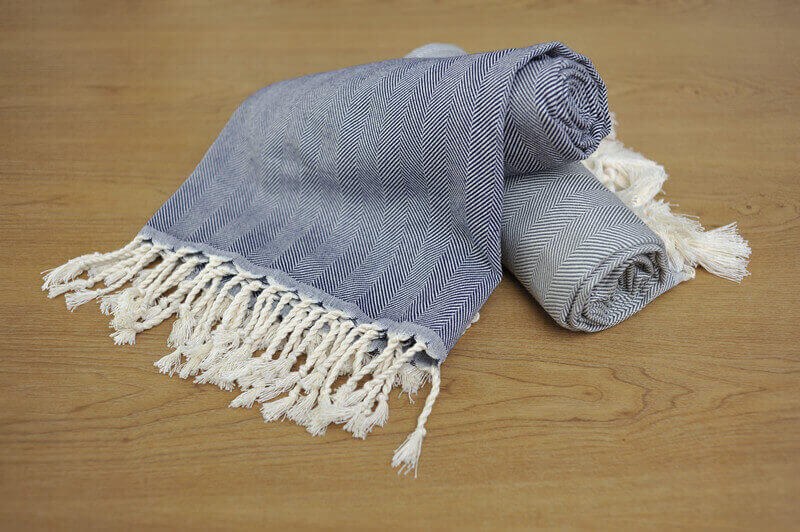
Short answer: Terry and fouta are not two grades of the same towel; they are two answers to different questions. Terry — the looped pile you know from every hotel bathroom — wins on sheer absorbency, plushness and warmth, which is why guest-room bathing stays a terry programme. Fouta — a flat-woven cotton towel with no pile at all — wins wherever the towel is carried rather than hung: it is lighter per piece, dries in roughly half the time, packs flat, resists sand, sheds no lint and doubles as a wrap, a throw or a sarong. Spas, beach clubs, pool decks, gyms and boutique retail buy fouta precisely because terry is wrong on those axes. The comparison table below settles the choice by use case, and the specification section lists what to pin down for each weave — because a fouta is not inspected on GSM alone.
What a fouta actually is — and what it is not
A fouta (the word overlaps heavily with peshtemal and “hammam towel” — the naming guide untangles that vocabulary) is a towel woven entirely from flat yarns: warp and weft interlace with no loop standing off the fabric. The body is usually a plain, honeycomb or herringbone weave, often crossed by wide woven bands, and both ends are finished with fringe or hand-knotted tassels. Because there is no pile, the fabric is thin, drapes like a sarong and dries at a speed terry physically cannot match — there are no loops to hold water in a deep capillary bed.
What it is not: a thinner, cheaper terry. Buyers who spec a fouta by terry logic — “make it 550 GSM” — end up with a stiff, dense fabric that has surrendered every advantage of the flat weave. A fouta is judged on weave construction, hand feel, weight per piece and finishing quality, not on the GSM bands that govern pile towels.
The two weaves, compared line by line
Neither weave is “better”. Each is measurably better at a specific job, and the honest comparison looks like this:
| Property | Fouta (flat weave) | Terry (looped pile) |
|---|---|---|
| Absorbency per contact | Moderate — wicks and spreads moisture, feels damp sooner | High — deep pile soaks and holds the most water |
| Drying speed | Very fast — typically dries in roughly half the time of terry | Slow — thick pile stays damp for hours in humid air |
| Weight & bulk | Light and flat; packs to almost nothing | Bulky and heavy; dominates luggage and linen shelves |
| Sand and debris | Shakes clean; sand will not lodge in pile | Sand and grit embed in the loops |
| Lint shedding | Minimal once washed — flat yarns stay put | Sheds lint through early washes |
| Plushness / warmth | Low — thin, cool, wraps like fabric | High — the “fluffy” signal guests read as luxury |
| Laundry economics | Faster dry, lower energy per cycle, holds shape well | Longer tumble, higher energy, pile flattens over years |
| Decoration & retail | Jacquard weaving, stripes and hand-tied fringe read as artisanal | Embroidery and borders; reads as classic hospitality |
Read the table by column: the left column is a towel that performs, the right column is a towel that pampers. Programmes fail when the wrong column is bought for the job — a fouta handed to a luxury suite guest as the bath towel reads thin, and a terry towel dragged across a sandy deck ruins itself after one season.
Where the flat weave wins
The fouta earns its place in five settings, and every one of them is about the towel living outside a heated, humid laundry loop:
- Spas and hammams. The flat weave wraps the body like a robe sheet, stays cool, dries between treatment rooms without a dryer cycle, and withstands the hot, wet wash cycles a hammam runs daily.
- Beach clubs and resort pool decks. Guests carry the towel to the water; it sheds sand with one shake, dries on the lounger and never turns into a sodden roll in the bag on the way home.
- Gyms and wellness studios. Members want a towel that survives the gym bag, dries in a locker overnight and does not smell of damp terry — the fast-drying flat weave is the honest answer.
- Boutique and hotel retail. A jacquard-woven fouta with hand-knotted fringe photographs like a fashion item and doubles as a throw or pareo, so it sells at a story price instead of a commodity price.
- Guest amenities and corporate gifts. It packs flat for welcome kits, weighs almost nothing per unit and carries an embroidered or woven brand without the bulk of a boxed terry towel.
Where terry stays the default
For all its virtues, the flat weave does not replace the guest-room bath towel, and it should not try:
- Guest bathing. Plushness is the luxury signal; the deep pile of a 500–600 GSM terry — the bands the bath towel GSM guide explains — delivers the hand feel a fouta never will.
- Maximum water pickup. Drying off after a bath is a contact-absorbency task, and pile loops hold several times more water than a flat surface.
- Warmth. A terry wrap traps air and insulates; a flat weave in an air-conditioned spa lounge can feel clammy.
- Uniformity. Terry’s plain field suits hotel identity programmes — consistent white, dobby borders, embroidered logos — across thousands of pieces.
Specifying a fouta that performs
A fouta order lives or dies on details terry buyers never wrote before. Pin these five down and the flat weave will do exactly what the sample promised:
- Weave and pattern. Name the body weave (plain, honeycomb, herringbone), band widths and colour placement in writing; a jacquard repeat changes both the look and the fabric’s stretch. A photo of the approved pattern belongs in the PO.
- Weight per piece, not GSM. Flat weaves are commonly bought by grams per finished towel, typically in the low hundreds — heavier is not better past the point where drape and dry speed suffer. Quote the band, not a single number.
- Size and shrinkage. Foutas are sized generous on purpose (used as wraps), but flat cotton still shrinks — agree a post-wash dimension with the tolerance logic from the cotton shrinkage guide, not a before-wash fantasy size.
- Fringe and finishing. Hand-knotted tassels are the artisanal signature but the first thing to fail; specify knot construction, length and whether the fringe is single- or double-wrapped. Reject straight-machine hemming sold as handwork.
- Chemical safety and fastness. For anything touching skin in a spa, ask for testing to OEKO-TEX STANDARD 100, and pin colourfastness grades for wash and rubbing on coloured yarns — deep indigo and striped dyes are where cheap foutas bleed.
One more line for the purchase order: state the intended use (“beach club pool deck”, “spa treatment room”). A mill that knows the setting will steer the construction — denser bands for retail, lighter body for gym programmes — instead of quoting blind against a single photo.
Buy the weave for the job, not the job for the weave
The costly mistake is not choosing the “wrong” fabric — it is ordering a fouta and then judging it by terry criteria (plushness, GSM), or ordering terry and expecting it to dry on a lounger. Each weave wins inside its own scoring system; write the scoring system into the specification before the deposit.
Laundry: fouta and terry in the same facility
If your programme mixes both weaves, the laundry is where the difference compounds season after season. Terry needs long tumble cycles to drive moisture out of the pile; a fouta spins nearly dry, air-dries on a rail overnight and ironing is optional, which trims both energy and turnaround. Flat weaves also resist the lint load that clogs dryer screens in terry-heavy houses. Wash both at the temperatures your care labels declare — the GINETEX care symbol system keeps those instructions readable by any laundry team worldwide, and mismatched washing between the two weaves is the quietest way to shorten a towel programme’s life.
Deck operations notice the same physics outside the laundry: a stack of damp terry left on a pool chair smells sour by evening, while a fouta is presentable again within the hour. For properties rotating towels through sun, salt and chlorine all day, that gap alone justifies carrying both weaves — the same logic the pool towel specification guide applies when separating deck towels from bath towels.
Terry pampers the guest in the room; fouta serves the guest outdoors. Properties that buy one weave for both jobs pay for the mismatch twice.
Frequently asked questions
What is the difference between a fouta and a terry towel?
Construction. Terry is woven with loops standing off the fabric (the pile), which makes it thick, plush and highly absorbent but slow to dry. A fouta is woven flat — no pile at all — so it is lighter, dries far faster, packs flat and sheds sand, at the cost of plushness and sheer water pickup.
Is a fouta towel as absorbent as terry?
No, and it is not meant to be. A fouta wicks and spreads moisture well for its weight and dries quickly between uses, but a deep terry pile holds more water in a single contact. For post-shower drying in a guest room, terry wins; for repeated poolside use where the towel must dry between dips, fouta wins.
What weight should I specify for a fouta?
Buy by weight per finished piece rather than by the GSM bands used for terry, typically in the low hundreds of grams depending on size and weave. Pin a band, not a single number, and judge the sample on drape and dry speed — pushing GSM up makes a fouta stiff and destroys its main advantage.
Do fouta towels shrink in the wash?
Yes, flat cotton shrinks like any cotton construction, usually a few percent after the first hot washes. Agree post-wash dimensions and a tolerance in the purchase order, and wash care-label temperatures; a fouta speced to its before-wash size will read short in the field.
How should I wash a fouta towel?
Follow the GINETEX care symbols on the label: a normal cotton wash, moderate tumble or line dry — line drying is genuinely fast for flat weaves. Avoid fabric softener on any towel; it coats fibres and reduces wicking. Wash separately for the first cycles as some deep dyed stripes may release colour initially.
Can one hotel programme carry both fouta and terry?
That is the standard answer for resort properties: terry in the bathrooms where plushness signals quality, fouta on the pool deck, beach, spa and retail shelf where drying speed, weight and look decide. Specify, inspect and launder each weave to its own rules rather than forcing one standard on both.
Two weaves, one supplier, no guesswork.
Tell us the programme — deck, spa, gym or retail — and we will quote fouta and terry side by side with weave, weight band, fringe and fastness specs written into the order.
Request a fouta and terry quote →Sinmal Production Team
Weaving & finishing, Sinmal Home Textile · Last updated October 2026
Keep reading
- Peshtemal, Fouta, Hammam or Turkish Towel? — The naming, untangled once and for all
- Hotel Pool Towels vs Bath Towels — What changes when the towel lives on the deck
- Bath Towel GSM Guide — The weight logic that governs the terry side
- Low-MOQ Custom Peshtemals — Test the flat weave without overbuying