
Hotel Pool Towels vs Bath Towels: What to Specify Differently
Short answer: A hotel pool towel and a bath towel look like the same product in different sizes, and that assumption is where pool programmes go wrong. A pool towel works in a harsher environment — chlorinated and sunlit water, sunscreen, sand, and two to three uses per guest per day — so the specification genuinely diverges: larger and differently proportioned sizes, a lighter but denser terry that dries fast, chlorine- and light-fast dyes, saturated colours that hide wear, and a tracking system, because pool towels walk away. Order pool towels on a bath towel spec and you get slow-drying, fast-fading inventory that is cheap to buy and expensive to keep.
Why a pool towel is not a big bath towel
A bath towel spends its life in one predictable loop: guest showers, towel goes to the laundry, comes back dry and folded. A pool towel lives outdoors in the hardest conditions a cotton product ever meets. It is soaked in chlorinated water, laid on concrete and lounge chairs under direct UV, coated in sunscreen oils, dragged across sand, used by guests who are wet from the pool and again by guests who are dry from the gym, and then laundered at hot wash temperatures several times a day. No other item in the linen programme takes that combination.
The consequences show up as different failure modes. Bath towels fail by going grey and flat from body oils and softener build-up over a long, gentle life. Pool towels fail in months, not years, and they fail visibly: colours bleach out in streaks, pile mats down where sunscreen sits, edges unravel from being dragged over rough surfaces, and roughly a fifth of the stock simply is not on property any more. Each of those failures maps to a line in the specification, which is why the two products should never share one spec sheet.
- Chemistry: chlorine attacks dye molecules directly, so a shade that survives a bathroom laundry can bleach out at the poolside in a single season.
- Light: UV degrades both dye and fibre — colours fade and cotton weakens where the towel sunbathes as hard as the guests do.
- Oils: sunscreen and tanning oils are hydrophobic; they cling to terry pile, attract soil and stiffen the hand feel.
- Turnover: a resort pool deck turns its towel stock two to three times daily, so dry speed and laundry capacity become operational constraints, not comfort details.
- Attrition: pool towels are the most stolen and most miscounted item in the programme — the spec has to plan for replacement and tracking, or costs drift permanently.
The spec side by side
Most of the practical differences compress into a single table. The bath towel column is what a typical hotel programme already buys; the pool column is what changes when the same mill is asked to quote for the pool deck:
| Spec line | Guest-room bath towel | Pool / beach towel | Why it differs |
|---|---|---|---|
| Size | 50×90 to 70×140 cm | 90×180 cm (35×70 in) standard, 100×180 premium | Body wrap and lounger coverage, not head and hands |
| Weight (GSM) | 500–600 GSM for hotel grade | 400–500 GSM | Lighter dries faster on a high-turnover deck and costs less to launder |
| Pile | Long, plush loop terry | Shorter, denser loop; often ring-spun cotton | Density keeps strength as pile height drops; less sand traps |
| Weave base | Terry with dobby border | Terry or flat-woven velour face with terry back | Velour face prints well and sheds sand; terry back still dries bodies |
| Colour strategy | White dominates; some dye | Saturated colour, yarn-dyed stripes or jacquard | Colour hides chlorine fade, sunscreen marks and between-wash wear |
| Dye fastness | Wash fastness is the priority | Chlorine and light fastness are the priority | The failure environment is the pool, not the laundry |
| Tracking | Room-count parity | Per-deck counts, woven ID, replacement buffer | Attrition at pools runs high; you cannot manage what you cannot count |
Two rows deserve a note. On weight: buyers often assume heavier means better, and for bath towels that instinct is mostly right — the bath towel GSM guide explains how weight drives absorbency and laundering life in the room. At the pool the logic flips: a 600 GSM towel soaked in pool water can hold the better part of a litre of water, takes far longer to dry on a rack or a lounger, and costs measurably more per wash in energy. Properties that run light, dense 400–450 GSM pool towels replace them less often, because the towel is not slowly rotting damp on a rack between uses. On colour: white is the bath programme default for bleachability and uniformity, but at the pool a saturated mid-tone — navy, teal, terracotta — masks the fading and staining that would make a white pool towel look defeated by mid-season.
Chlorine, sunlight and what actually kills a pool towel
Chlorine is an oxidiser, and oxidisers do not discriminate between the molecules in pool water and the chromophores that make a dye a dye. A dye’s resistance to this attack is measured as chlorine fastness, and its resistance to UV as light fastness; both are graded on standardised lab procedures and reported as a numeric grade. This is exactly the kind of claim worth attaching a test method and a minimum grade to in the purchase order, instead of the word “colourfast”. A mill that dyes for the pool will answer with numbers; one that just re-labelled bath stock will answer with adjectives. And because a pool towel stays pressed against wet skin for hours, the dye chemistry should also clear a recognised safety bar — the limits for dyes and finishes under the OEKO-TEX STANDARD 100 are the reference most hospitality programmes quote.
Sunscreen is the quieter killer. The oils do not fade colour directly, but they sit in the pile, oxidise in sunlight, attract poolside dust and steadily stiffen the hand. Properties fight this with wash chemistry — hotter main wash, emulsifying detergent, no softener on pool stock, because softener coats the pile and cuts absorbency. The specification supports it on the construction side: a denser, slightly shorter pile holds less oil and releases it in the wash better than a long loose plush pile, which is one more reason the plush bath towel spec is the wrong starting point.
Ask how the towel was dyed, not just which colour it is
Yarn-dyed stripes and jacquard put the colour inside the yarn before weaving, which is why a ten-year-old striped pool towel can still read as bold while an over-dyed piece bleaches out in one season. For printed logos and designs on pool towels, demand chlorine-tested inks and a wash-test swatch before bulk — the print methods comparison covers how each technique behaves outdoors.
Dry speed is a spec, not a nicety
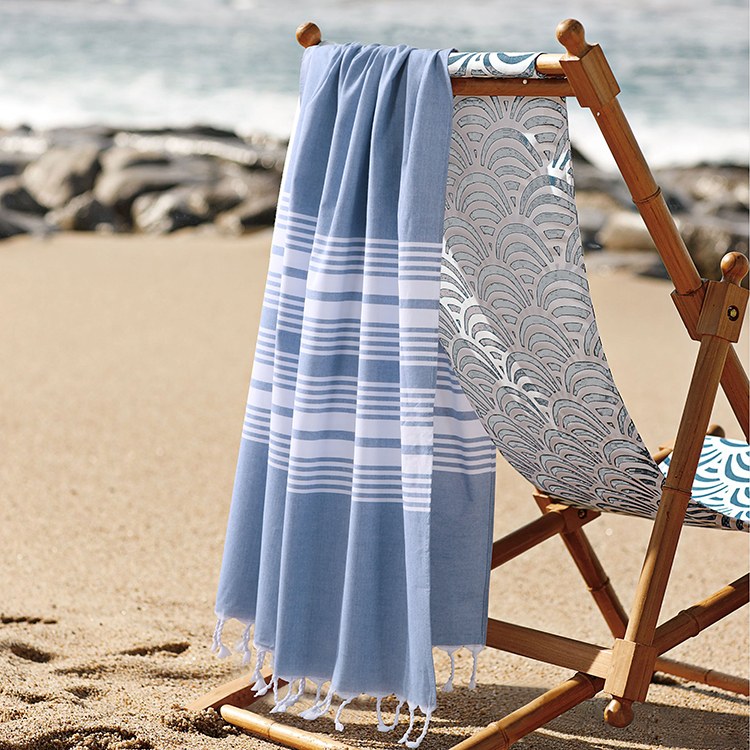
On a resort deck the towel’s drying time is inventory. A towel that is still damp at 5 p.m. is a towel a guest will not reuse, so housekeeping pulls a fresh one, and the same cotton then goes through the wash two or three times a day instead of once. Every extra cycle is energy, chemicals, labour and mechanical wear on the fabric — the real cost of a heavy, slow-drying towel is not on the quote, it is in the laundry ledger. Three construction choices buy dry speed: the lighter GSM band discussed above, a denser shorter pile that releases water mechanically, and, increasingly, a combed ring-spun yarn that keeps strength at lower weight. Some programmes also move part of the deck to flat-woven fouta-style towels, which dry dramatically faster than terry — the trade-off in plushness is exactly the peshtemal versus terry towel difference, and pool-heavy properties increasingly stock both: terry for the body-wrap feel, flat weave for the lounger and the cabana.
Loss, tracking and the replacement buffer
Pool towels walk. Guests carry them back to rooms, leave them in loungers, pack them by accident, and occasionally take them home as souvenirs. Industry experience puts poolside attrition at a level that would be an emergency anywhere else in the linen programme, and the response is procedural, not punitive:
- Count per deck, not per property: issue in, collect out, every shift, so a shrinkage pattern shows up in days rather than at the annual inventory.
- Mark the product: a woven edge label or jacquard ID with the property name both brands the towel and quietly signals that it belongs to the pool, not the gift shop.
- Separate the stock: pool towels in their own size and colour code never enter the room supply, so the two programmes’ counts stay clean and reorder maths stays honest.
- Buffer for attrition: order against an expected loss rate — properties typically plan a percentage-of-stock annual replacement for poolside specifically — rather than replacing only at failure.
- Grade the retirements: towels that fail appearance checks at the pool often get a second life as gym or spa utility stock, which stretches the buy without diluting the guest-facing deck.
None of this works if the towel itself is not built to be counted and marked, which is why tracking belongs in the specification — woven label, size tag, colour code — and not in an email to housekeeping after the first season’s numbers come in. Keep the laundering instructions on the same woven label, using the standard international care symbols published by GINETEX, so that laundry teams in any country read identical instructions from the same five symbols.
Writing the pool programme into the RFQ
Everything above reduces to a short list of lines that separate a pool spec from a bath spec. Bring these to the quote and the two products stop being confused on both sides of the table:
- State the use: poolside, outdoor, chlorinated — so the mill dyes for the environment, not the catalogue photo.
- Size in the pool band: 90×180 cm as the workhorse, one larger size for premium rooms or cabanas, and no bath-towel dimensions on the pool line.
- Pin the GSM band at 400–500 with a denser pile construction, and ask for the dry-speed logic, not just the number.
- Name the fastness tests and minimum grades for chlorine and light, and require a washed swatch from the actual dye lot before bulk.
- Choose colour for the deck: saturated yarn-dyed stripes or jacquard that age gracefully, with the property mark woven or printed where it will survive laundering.
- Plan attrition in the contract: annual replacement percentage, tracking method, and the retirement path for towels that leave guest-facing service.
For properties that want logos or designs on pool towels, the production choice matters as much as the fabric: digital and screen print methods, yarn-dyed jacquard and their durability trade-offs are compared step by step in the beach towel print methods guide, and sizing across the whole bath and pool range — including why the 90×180 format became the resort standard — sits alongside the bath towel and bath sheet size guide.
A bath towel is judged after a shower; a pool towel is judged after a season. Specify for the season, not the shower.
Frequently asked questions
What size should hotel pool towels be?
The resort standard is 90×180 cm (about 35×70 inches): large enough to wrap an adult and cover a lounger, still manageable in laundry carts and on racks. Premium properties often add a 100×180 cm tier for cabanas and suites. Bath towel sizes do not scale up to this role — the proportions are different, not just bigger.
What GSM is best for pool towels?
Most successful programmes run 400–500 GSM: lighter than guest-room bath towels (500–600 GSM) because a soaked pool towel must dry fast on a high-turnover deck and costs less to launder. Pair the lower weight with a denser, shorter pile and ring-spun yarn so strength does not drop with the GSM.
Why do pool towels fade faster than bath towels?
Chlorine oxidises dye molecules and UV degrades both dye and fibre — two attack paths a bathroom towel never meets. Specify chlorine and light fastness by named test method with minimum grades, and prefer yarn-dyed construction, where the colour is inside the yarn rather than applied to finished pile.
Can we just use guest-room bath towels at the pool?
It works briefly and fails expensively. The bath spec brings heavy, slow-drying fabric, white colourway that shows every poolside stain, dye chosen for wash fastness rather than chlorine fastness, and no tracking marks. Properties that tried it usually end up buying a real pool programme within the first season anyway.
How many pool towels should a hotel stock?
A common starting point is two to three times the peak simultaneous pool users, adjusted for laundry turnaround — faster drying and faster laundry cycles lower the multiplier. Because attrition is high, plan an annual replacement percentage for the pool stock separately from the room linen reserve.
Are flat-woven fouta towels a good pool towel?
They are an excellent complement, not a full replacement. Flat-woven peshtemal-style towels are lighter, dry far faster and shake sand off easily, which suits loungers and cabanas; plush terry still wins for the body-wrap feel guests expect after a swim. Pool-heavy properties increasingly stock both and let the deck position decide.
Pool towels built for chlorine, sun and season two.
Tell us the deck size and laundry setup, and we will quote a pool programme with fastness-graded dyes, the right GSM band, woven property marking and a replacement plan.
Request a pool towel quote →Sinmal Production Team
Weaving & finishing, Sinmal Home Textile · Last updated October 2026
Keep reading
- Bath Towel GSM Guide — Where the 400–600 GSM logic comes from — and where it flips
- Beach Towel Print Methods — Digital, screen or jacquard for a design that survives the sun
- Peshtemal vs Terry Towel — The flat-woven option decks are stocking beside terry
- Bath Towel vs Bath Sheet Sizes — How towel formats are sized across the whole programme
- Fouta vs Terry Towels — Why the flat weave takes the deck and terry keeps the bath