
Peshtemal, Fouta, Hammam or Turkish Towel: What Is the Difference?
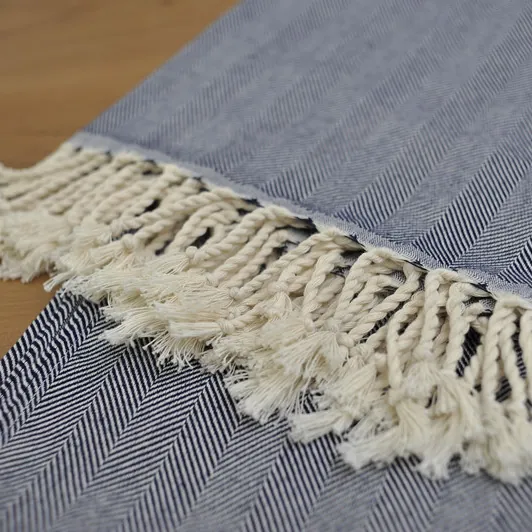
Short answer: All four names describe the same family of flat-woven, thin, fast-drying cotton towels. They differ in origin, size convention and finishing rather than in category. Peshtemal and hammam towel are Turkish and refer to the traditional bath towel of the hammam. Fouta is the North African and French word for the same family, classically larger and often plainer with a hand-tied fringe. Turkish towel is the general English retail term for all of it. None of the four tells you the GSM, the size, the weave density or the fringe type — which is why a specification written in names is a specification waiting to be misread.
Four names, one family
Start with what they have in common, because it is most of the product: a flat weave rather than a loop pile, a relatively low weight per square metre, a long float that gives the cloth its drape, and an edge finished with fringes rather than a hem. That combination is what makes the group distinct from terry, and it is why a peshtemal dries in a fraction of the time a terry towel of similar size needs.
| Name | Where it is used | What it usually signals | What it does not tell you |
|---|---|---|---|
| Peshtemal | Turkish | Traditional flat-woven bath towel; often finer, with a woven or jacquard border | GSM, size, fringe type, weave density |
| Hammam towel | Turkish / English | Literally the bath towel of the hammam; frequently interchangeable with peshtemal | Anything about construction |
| Fouta | North Africa, France | The same flat-weave family; classically larger, plain or striped, hand-tied fringe | GSM, exact size, border design |
| Turkish towel | International retail | An umbrella marketing term covering the whole family | Every technical property |
The fouta is the term worth pinning down, because it travels between two languages. French usage has carried the word from the Maghreb into mainstream retail vocabulary, and a dictionary definition will give you the cloth and its traditional use but never the numbers a buyer needs. For the word itself, the French lexicographic reference at CNRTL is a useful starting point — and a good reminder that a dictionary entry describes a textile, not a purchase order.
Why the confusion is commercial, not academic
In practice, buyers do not get into trouble because they mix up the history of two words. They get into trouble because two suppliers both answer “peshtemal, 100 by 180, 400 grams” and ship visibly different towels. One used a tighter weave with a jacquard border and a hand-knotted fringe; the other used a looser cloth, a printed border and a machine-finished edge. Same name, same headline numbers, different product.
The reverse happens too. A buyer asks for a “fouta” expecting the larger, plainer article that the term traditionally implies, receives a striped peshtemal, and concludes the mill substituted something — when in fact the enquiry never specified a difference that could be detected. Names are a starting point for a conversation; they are not a substitute for a specification.
What the name does not tell you
Here is the list of things that decide whether the towel in the box is the towel you thought you ordered. Every one of them is invisible in the name:
| Spec field | Why the name fails you |
|---|---|
| Weight — GSM and piece weight | Two towels with the same headline weight can differ once the size changes; piece weight is what a guest feels |
| Size in centimetres | Varies widely within the family, and shrinks — you need to know whether the figure is before or after washing |
| Weave construction | Flat weave covers a range of densities; density drives drape, absorbency and how the towel ages |
| Border | Jacquard, yarn-dyed or printed are three different costs and three different looks |
| Fringe | Hand-tied, machine-tied, knotted or simply cut — a large cost difference and the first thing to look tired |
| Yarn | Combed or carded, ring-spun or open-end; decides whether the surface survives a hundred washes |
| Colourfastness | Matters more here than on terry, because a flat weave shows a faded dye lot immediately |
| Shrinkage tolerance and certification | Neither appears in any of the four names, and both are contractual |
Writing a spec that survives translation
The fix is mechanical rather than clever: never let a name carry information that a number could carry better. A complete enquiry for this product family reads like this.
- Name the product and the construction: flat-woven cotton, and the weave reference or a physical sample.
- State piece weight in grams, not only GSM — and state it for the finished size you actually want.
- Give the size in centimetres, and say whether it is measured before or after washing.
- Say how the fringe is finished and how long it is; ask for the fringe to be specified, not assumed.
- Say how the border is made — jacquard, yarn-dyed or printed — and attach the artwork if it is printed.
- Name the yarn: combed or carded, and the spinning method if you care about surface life.
- Set the colourfastness expectation and the wash test it will be judged against.
- State the shrinkage tolerance and the certification target for the exact fabric.
- Finish with the packing and carton format, because carton volume affects the freight line as much as the towel does.
The two-minute test you can run on any supplier
Send them only the name — “peshtemal” or “fouta” — with no numbers, and see what comes back. A real mill replies with questions: size, weight, border, fringe, yarn, wash standard. Someone forwarding a catalogue replies with a price. Which answer you get tells you more about the supplier than the four names ever could.
The numbers behind the vocabulary
Once the name is out of the way, the same discipline you would apply to any towel applies here. Weight and size are the two variables that move the price most, and they move it together — a larger size in the same cloth adds weight, and a heavier cloth at the same size adds cost on both the fabric and the freight line. Border and fringe are the next largest levers, and they are precisely the two fields that a name-based specification leaves blank.
That is also why two quotes for “the same” peshtemal can sit a long way apart and both be honest. One is a lighter cloth with a printed border and a machine finish; the other is heavier, jacquard-woven and hand-finished at the fringe. Before comparing the numbers, compare the specification — and if a supplier will not break the price down by weight, border and fringe, ask again. Our note on how to tell a real mill from a trading company covers why that breakdown matters so much.
The four names are a marketing language. The specification is the technical one. Only one of them is safe to order from.
Frequently asked questions
Is a peshtemal the same as a Turkish towel?
In retail, almost always yes — “Turkish towel” is the umbrella English term and peshtemal is the specific Turkish one. Technically the peshtemal is one member of the family, but the two are used interchangeably for the flat-woven cotton towel most buyers mean.
What exactly is a fouta?
The North African and French word for the same flat-woven family, traditionally larger, often plain or simply striped and finished with a hand-tied fringe. Because the term travelled through French, it appears in retail marketing far more often than in technical specifications.
Are hammam towels and peshtemals different products?
They are effectively the same idea under two words: hammam towel says where it is used, peshtemal says what it is. Neither word constrains the GSM, the size or the finishing, so both must be specified numerically.
Why are these towels so thin compared with terry?
Because the flat weave and long float create a large, draping surface with very little material. That is what makes them fast-drying a thin towel. The trade-off is a different hand feel and less surface cushioning than a loop-pile towel of similar size.
Are flat-woven towels absorbent?
Yes, and often more than buyers expect once washed — the issue is usually a new towel with a dressing or finishing agent still on the cloth, not the construction. Absorbency improves over the first few washes rather than declining, provided softener is dosed properly.
Is “Turkish cotton” a real specification?
Not on its own. It describes a fibre reputation, not a measurable property. Yarn count, combed or carded, spinning method and the fabric construction are the fields that actually decide how the towel behaves, and those are the fields a specification should carry.
Send us the name. We will send back the questions.
Tell us the product family and your market. We will come back with size, weight, border, fringe and yarn options that are actually comparable — and physical samples you can wash before you decide.
Request peshtemal samples →Sinmal Production Team
Weaving & finishing, Sinmal Home Textile · Last updated October 2026
Keep reading
- Telling a Real Peshtemal Mill From a Trader — Twelve questions that require numbers
- Sample vs Bulk Quality — Why the approved piece and the shipment diverge
- Low-MOQ Custom Peshtemals — Testing a market from a small run
- Fouta & Peshtemal Towels — Our weaves, sizes and custom options