
Low-MOQ Custom Peshtemals: How to Test a Market Without Overbuying
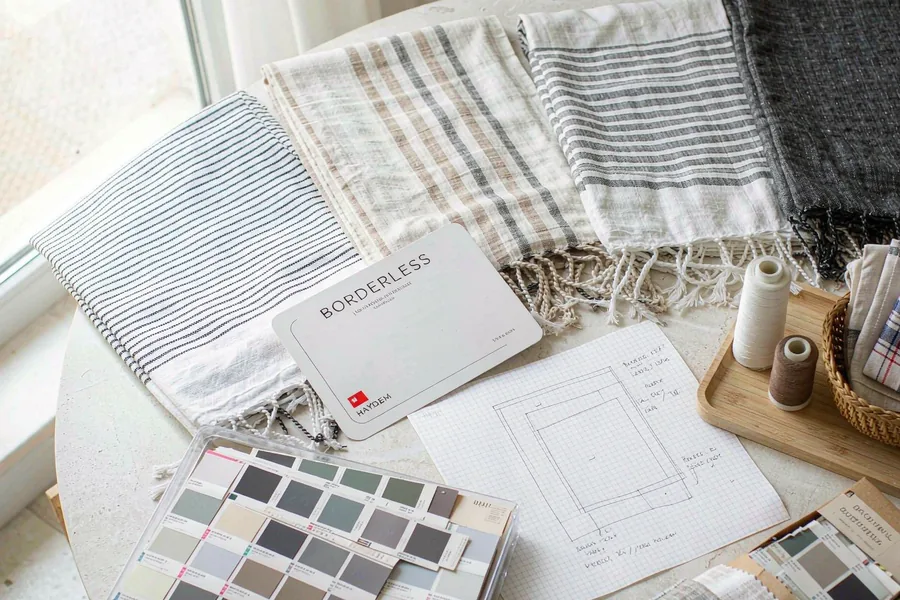
Short answer: A real mill can produce a custom peshtemal from 300 pieces — sometimes fewer — because a low-MOQ order is a scheduling question, not a technical one. The reason most quotes start at 1,000 pieces is that a middleman must reach the factory minimum and recover their own margin on top. This guide shows what actually drives a towel MOQ, where 300 pieces is realistic and where it is not, and how to structure a small first order that answers your real question: does this design sell?
Why MOQs exist (it is not greed, mostly)
Every part of a custom towel has a setup cost that is the same whether you make 50 pieces or 5,000:
- Warping. Threading the loom with your colourway takes hours of skilled labour regardless of run length.
- Dyeing. A dye batch has a minimum liquor volume. Dyeing 3 kg of yarn and 30 kg costs nearly the same to set up.
- Jacquard setup. Loading your woven pattern onto the loom is a fixed cost per design.
- Labels and packaging. A woven label run has a minimum; printed hang tags have plate costs.
- QC and administration. Checking, documenting and shipping an order costs roughly the same at any size.
Spread those fixed costs over 300 pieces and they are painful per unit. Spread them over 3,000 and they disappear. That is the entire economics of the MOQ — and it means a low MOQ is a scheduling and efficiency concession a mill makes, not a magic trick. The mill is agreeing to eat some inefficiency, usually because it wants your repeat business.
The middleman MOQ trap
A trader cannot pass the mill’s inefficiency discount to you, because they do not receive it — they are one of many buyers. Their floor price at 300 pieces is the mill’s 3,000-piece price plus 15–30%. This is why the same “low MOQ” search returns quotes that differ by 40%: you are often comparing a factory’s concession with a middleman’s arithmetic.
The real math: what a small order should cost
Numbers matter more than adjectives. Below is how unit cost typically moves for a 90×170 cm yarn-dyed peshtemal with a woven label, based on how the fixed costs spread. Exact prices vary by spec and season — the ratios are the useful part.
| Order size | Relative unit cost* | What you get | What you give up |
|---|---|---|---|
| 300 pcs | 100% (baseline) | Full custom colourway + woven label; a genuine market test | Highest unit cost; fewer colour options per run |
| 500 pcs | ~88% of baseline | The efficiency sweet spot for most first programs | More cash tied up before any sales data |
| 1,000 pcs | ~76% of baseline | Two colourways becomes affordable; better freight rate per unit | You are committing before the market answers |
| 3,000+ pcs | ~65% of baseline | Factory-direct economics fully kick in | Only sensible after a proven repeat order |
*Relative unit cost = the unit price at that quantity, expressed as a percentage of the 300-piece price. The actual dollar figure depends on yarn prices, dyeing, weave and the season you book — which is exactly why we quote per project instead of publishing numbers that would be wrong next quarter.
Read the table this way: moving from 300 to 500 pieces cuts roughly 12% off each towel; moving from 500 to 1,000 ties up roughly double the cash before you have sold a single towel. For a first order in an unproven design, the 300-piece option is usually the rational one even though the unit price looks worse. You are not buying towels at that stage — you are buying information.
How to structure an order the mill can actually say yes to
A low MOQ works when the order avoids re-triggering the fixed costs. Four levers, in order of impact:
- One colourway per run. The warp is threaded once for your whole quantity. Two colourways means two setups; three means three. Start with the one colour your market data actually points to.
- Use an existing base construction. A 90×170 cm flat weave on a standard loom width is a normal request. An unusual size or a new jacquard repeat is a development project, and development projects carry minimums.
- Standard label over full packaging. A woven brand label sewn into the fringe is included in small runs by most mills. Belly bands, printed sleeves and custom cartons each add their own minimum — add them on the second order.
- Book into a scheduled run. Mills often have a warp partially threaded or a dye slot open. Asking “what can you slot in this month?” regularly unlocks 300-piece pricing that a fixed-date request cannot.
The phrase that works
“This is a market test for a design we intend to reorder every 6–8 weeks if it sells.” Mills price small first orders against the lifetime of the program, not the size of the first PO. Telling them the second order is the goal changes the number you are quoted.
The 300-piece market test, done properly
A small first order is only worth the setup cost if you actually measure what it came to tell you. A clean test looks like this:
- Split the 300 across your channels deliberately — e.g. 150 to your own store, 100 to your best wholesale account, 50 to influencer seeding. One channel proves nothing; three triangulate.
- Track sell-through weekly, not monthly. The number that matters is weeks-of-cover. If 300 pieces sell through in four weeks at full price, you have your reorder signal.
- Collect the qualitative signals before the quantitative ones. What do customers say unprompted? Which colour is requested that you did not make? What returns reason comes up twice? This is the product development data that pays for the next order.
- Reorder at 500–800, not 3,000. The second order is where the unit price improves while your risk stays bounded. Brands that jump from a 300 test straight to a container skip the step where most of the learning happens.
Where a 300-piece MOQ is genuinely not possible
Honesty on this point saves everyone weeks. Some customisations carry their own minimums that no mill can waive:
- Fully custom jacquard patterns — loading a new woven design has a real setup; below roughly 500–1,000 pieces the unit cost usually stops making sense.
- Custom colour matching to a Pantone chip in a new yarn — the dye development itself has a minimum batch.
- Custom printed packaging — print plates and minimum print runs exist at the printer, not at the mill.
- Mixed-size sets (bath + hand + face in one custom colourway) — each size is effectively its own production order.
The workaround for all four is the same: run the small test on a standard construction with a standard label, and pay for the full customisation on the reorder, when the sell-through data justifies it.
Frequently asked questions
What is a realistic MOQ for custom peshtemal towels?
For a custom colourway with a woven brand label on a standard construction, 300 pieces per colour is a realistic and commonly available minimum from an actual mill. Below that, you are usually looking at stock designs with a sewn-on label rather than true production. Quotes starting at 1,000+ for a basic custom order are typically either traders or mills protecting a busy schedule.
Why is the unit price at 300 pieces so much higher?
Fixed setup costs — warping, dyeing, jacquard loading, label minimums — are spread across fewer units. The cotton and labour are the same. A unit price 20–30% above the 1,000-piece rate is normal and honest; anything more than double usually signals a trader rather than a mill.
Can I mix colours within a 300-piece MOQ?
Sometimes, on an existing warp. A mill with a running production in your base construction can often split the weft colours across your quantity at little or no setup cost. What costs extra is a new colourway, because that is a new warp. Ask what is already on the looms.
Is it better to order 300 custom pieces or 1,000 stock pieces with my label?
For a first order, the 300 custom pieces. Stock designs with your label test your packaging and channel, not your product. A custom colourway on a standard construction tests the product itself at a modest premium — and product-market fit is the thing you actually need to learn.
How fast should a 300-piece order ship?
A realistic production lead time for a 300-piece custom run is 3–4 weeks after sample approval, plus transit. If a supplier quotes 10 days for a custom order, they are shipping stock and relabelling it — which is fine, but it is not what you asked for.
Ask what we can slot in this month
We run our own looms, so 300-piece custom colourways are a scheduling question, not a favour. Tell us your design and your market — we will tell you honestly what is possible, what it costs, and what cannot be done at that size.
Request a quote →Sinmal Production Team
Weaving & finishing, Sinmal Home Textile · Last updated September 2026
Keep reading
- Why Your Sample Doesn’t Match the Bulk Order — The five variables that drift, and how to lock them
- Fouta Peshtemal Towels — Weaves, sizes and custom options from our mill
- Our ordering process — From spec sheet to shipment, step by step