
How to Tell a Real Peshtemal Mill From a Trading Company
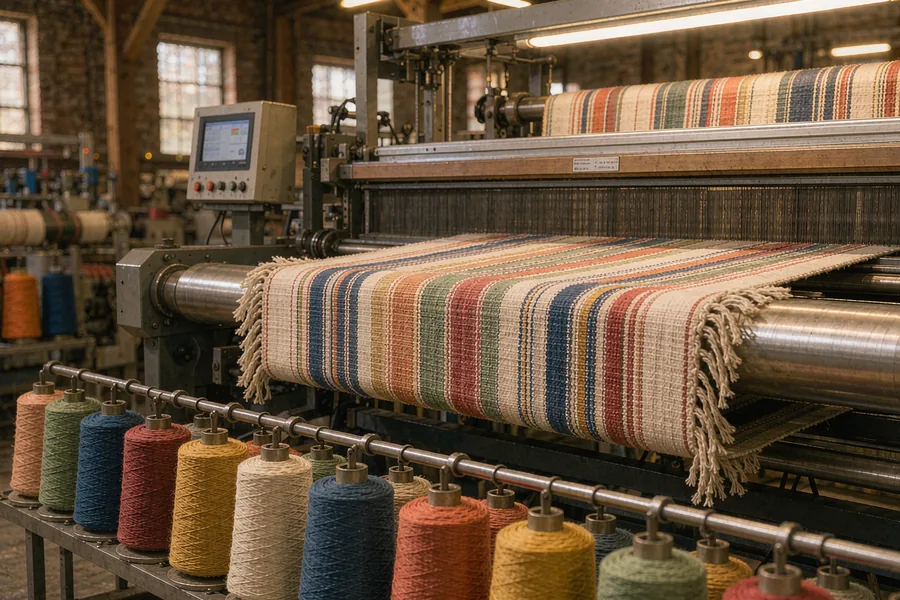
Short answer: There are only two reliable ways to tell them apart: ask questions that require numbers, and ask to see the looms. A trading company answers in generalities (“high quality”, “many years experience”) and redirects you to a photo gallery. A real mill answers with machine counts, GSM tolerances, dye-lot procedures and waste rates — and will put a camera on the weaving floor. Below are the 12 questions, what a genuine answer sounds like, and a 3-minute check you can run on your current supplier.
Why the middleman costs more than the markup
Anyone can put the words peshtemal manufacturer on a website — there is no certificate for the claim. The obvious cost of buying through a trader instead of the company that owns the looms is the margin: typically 15–30% added to the ex-mill price. But the markup is rarely the expensive part. What actually hurts is everything downstream of it.
- Your spec passes through a game of telephone. You say “300 GSM, jacquard border, hand-tied fringe”. By the time it reaches the loom it is whatever the trader wrote down. Nobody on the buying side ever sees the order sheet that production actually works from.
- Nobody owns quality. When 8% of a shipment has dye-lot variation, the trader blames the factory, the factory says it followed the order, and you are the one holding a container of uneven towels.
- Customisation collapses. A trader has to re-sell your custom design to a factory that has no relationship with you. Small changes that would be a five-minute conversation with a mill become a negotiation with two parties who each want a buffer.
- Your deadline is somebody else’s spare capacity. A mill schedules its own looms. A trader is queued behind that mill’s direct customers — and in peak season, guess who gets bumped.
- There is no fix after the fact. A real mill has your order history, your approved sample and your dye recipes on file. A trader has an email thread.
The tell nobody mentions
Ask the same technical question twice, three weeks apart. A trader answers from memory and the two answers rarely match. A mill answers from its production system, and the numbers line up because they were never guesses.
The 12 questions
Ask all twelve. You are not looking for perfect answers — you are looking for answers that could only come from someone standing next to a loom. A genuine mill will get through these in one reply. A trader will answer three, deflect four, and ask you for your target price.
1. What is your monthly weaving capacity, in pieces, and how much is currently free?
✓ A mill says: Gives a concrete number of looms and a monthly piece range, then tells you honestly how much of it is already committed. Some will say “we can fit 12,000 pieces in October, not more”. That limit is a good sign, not a bad one.
✗ A trader says: “We can handle any volume you need.” Unlimited capacity is not a factory — it is a promise nobody has to keep.
2. What loom type do you run for jacquard, and what is the maximum weft repeat?
✓ A mill says: Names the actual machine family and its limits, and tells you which patterns are awkward on it. Real answers include constraints.
✗ A trader says: Changes the subject to “we have many patterns available”, or forwards you a catalogue PDF.
3. Can we have a live video call from the weaving floor while our order runs?
✓ A mill says: Yes — and often offers unprompted. They will walk the floor, show you the loom, and point at the batch tag with your order number on it.
✗ A trader says: “Our factory does not allow visits.” A trader has no floor to show you. This single question eliminates most of the field.
4. Do you dye in-house or send out, and do you dye yarn or finished pieces?
✓ A mill says: Explains the difference and tells you which method they use for your product and why. Yarn-dyed versus piece-dyed is a real technical decision with cost and colour-fastness consequences, and they will talk about it for ten minutes.
✗ A trader says: Says “both” without explaining when each is used. If they cannot describe the trade-off, they are not placing the dye orders.
5. What are your warp and weft yarn counts, and is the cotton combed?
✓ A mill says: Gives numbers — yarn counts, combed or carded, and where the cotton is sourced. This is the specification that decides how the towel feels after fifty washes.
✗ A trader says: “100% premium Turkish cotton.” That is marketing copy, not a specification.
6. Who finishes the fringe — your own staff or a subcontractor?
✓ A mill says: Knows exactly, and can tell you how many people do it and how long it takes per piece. Hand-tied fringe is labour, and labour is scheduled.
✗ A trader says: Has genuinely never thought about it. Fringe quality is one of the first things to slip when nobody owns the last step.
7. What was your defect and waste rate on the last 10,000 pieces?
✓ A mill says: Answers with a percentage and often a reason — “we ran 2.1% on the last jacquard run because the weft colour was difficult”. A mill measures this because it costs money.
✗ A trader says: Has no data, because they never see the rejects.
8. Which certifications are registered in your own company name?
✓ A mill says: Can send you the certificate with their own legal entity on it, in scope, in date.
✗ A trader says: Sends a certificate belonging to a factory you have never heard of, and hopes you do not read the header. Always read the header.
9. What is your factory address, and can a third-party inspector visit before shipment?
✓ A mill says: Gives an address and welcomes the inspection — many will suggest it themselves for first orders.
✗ A trader says: Offers an office address, or says inspections are “not necessary for small orders”.
10. If a repeat order comes out a shade off, what is your process?
✓ A mill says: Describes something specific: keeping a retained sample and dye recipe per lot, dyeing the repeat against it, and re-running if it falls outside tolerance. This is the question that reveals whether consistency is a system or a hope.
✗ A trader says: Says “it will be the same”, which is not a process.
11. Can you make a production sample on the actual loom before bulk?
✓ A mill says: Yes. They will pull a piece off the running loom, under real production conditions, and send it for your approval before committing the full order.
✗ A trader says: Offers a hand-made sample or a piece from existing stock. This is exactly how “the sample was beautiful, the bulk was not” happens.
12. What is the ex-mill price, broken down by weave, dye, finishing and packing?
✓ A mill says: Can split the cost because they own the cost centres.
✗ A trader says: Quotes one blended number and resists breaking it down. A single opaque figure is where the margin hides.
Mill and trading company, side by side
| What you ask | Real mill | Trading company |
|---|---|---|
| Capacity | Concrete loom count and free slots | “Any volume you need” |
| Live floor video | Yes, and they offer it | “Factory does not allow visits” |
| Yarn spec | Counts, combed/carded, origin | “Premium Turkish cotton” |
| Dyeing | In-house or named partner, method explained | “Both”, unexplained |
| Defect rate | A percentage, with context | No data |
| Certificates | In their own entity name | Borrowed from an unnamed factory |
| Sample vs bulk | Production sample from the running loom | Stock piece or handmade sample |
| Price breakdown | Split by weave / dye / finish / packing | One blended number |
| After a bad lot | Retained sample and dye recipe on file | An email thread |
| New patterns | A conversation | A re-quote with a buffer |
The 3-minute self-check
Before you send the twelve questions, you can usually call it on your current supplier in three minutes.
- Look at the photos. Real mill photos are badly lit, have clutter in the background, and show the same floor from different angles over time. Stock imagery and flawless renders usually mean there is nothing to photograph.
- Look at the address. Search the address on a map. A mill sits in an industrial zone with loading bays. A trader sits in an office tower or, increasingly, in a residential unit.
- Look at the quotation. Count how many cost components are broken out. Three or more usually means the sender owns those cost centres.
- Look at the reply time and the reply. A trader answers instantly and vaguely. A mill answers in a few hours with numbers, and asks you a question back about your market. That question is the best sign of all.
What a direct mill relationship actually changes
It is not only about saving the markup. Once you are dealing with the peshtemal manufacturer rather than a reseller, three things change that a price comparison will never show you.
- Small volumes become possible. A mill can put 300 pieces on a loom that is already threaded. A trader has to reach the factory minimum before adding their own margin on top, so their effective floor is higher.
- Your history becomes an asset. Your approved sample, your dye recipe, your GSM tolerance and your last three order quirks sit in one production file. Repeat orders get more accurate over time instead of resetting every season.
- Problems get solved instead of argued about. When something is wrong, you talk to the person who can fix it. There is no third party whose incentive is to make the question go away.
The right question is not “who is cheapest”. It is “who will still be answering my emails in three years, when this is my best-selling line.”
Frequently asked questions
Is a trading company always a bad choice?
No. A good agent can be genuinely useful: they handle sourcing across several factories when you need a wide assortment, and they absorb some coordination work. The problem is not traders existing — it is a trader presenting themselves as a mill. Buy on a trader’s terms, knowingly, or buy from a mill directly. What you should not do is pay mill-direct prices for a middleman’s service.
What if a supplier says they are both a mill and a trading company?
Some real mills do trade other products they do not weave, most often to round out an assortment for existing customers. That is legitimate. Ask which specific products are theirs and which are bought in. A mill with nothing to hide will answer that immediately.
How do I verify a factory without flying there?
Three ways, in increasing cost. First, a live video call during a scheduled production run — the timing matters, because a real floor is always doing something. Second, a paid third-party inspection (SGS, Bureau Veritas, QIMA) for the first order; most mills accept this and many will suggest it. Third, put a small trial order through and watch how accurately the production piece matches what was promised. The third test is the one that predicts the next three years.
Does buying direct from a mill mean higher minimums?
Usually the opposite, and this surprises people. Traders need to clear the factory minimum and add their margin, so their practical floor is often higher than the mill’s. A mill deciding whether to run 300 pieces of your design on an existing warp is making a very different calculation.
What is the single strongest signal?
They say no to something. A supplier who can only ever say yes has nothing to protect and nothing to schedule. When a mill tells you a colour will be difficult, a date is tight, or your artwork will not survive a certain weave, they are telling you they intend to make it correctly.
Talk to the people who run the looms
Sinmal Home Textile has been running its own weaving and finishing since 2006. Ask us the twelve questions — capacity, yarn counts, defect rates, certificates in our own name. We will answer all of them, and put a camera on the floor.
Request a quote →Sinmal Production Team
Weaving & finishing, Sinmal Home Textile · Last updated September 2026
Keep reading
- Low-MOQ Custom Peshtemals — How to test a market from 300 pieces
- Fouta Peshtemal Towels — Our own mill: weaves, sizes and custom options
- Our quality control process — How every order is checked before it ships